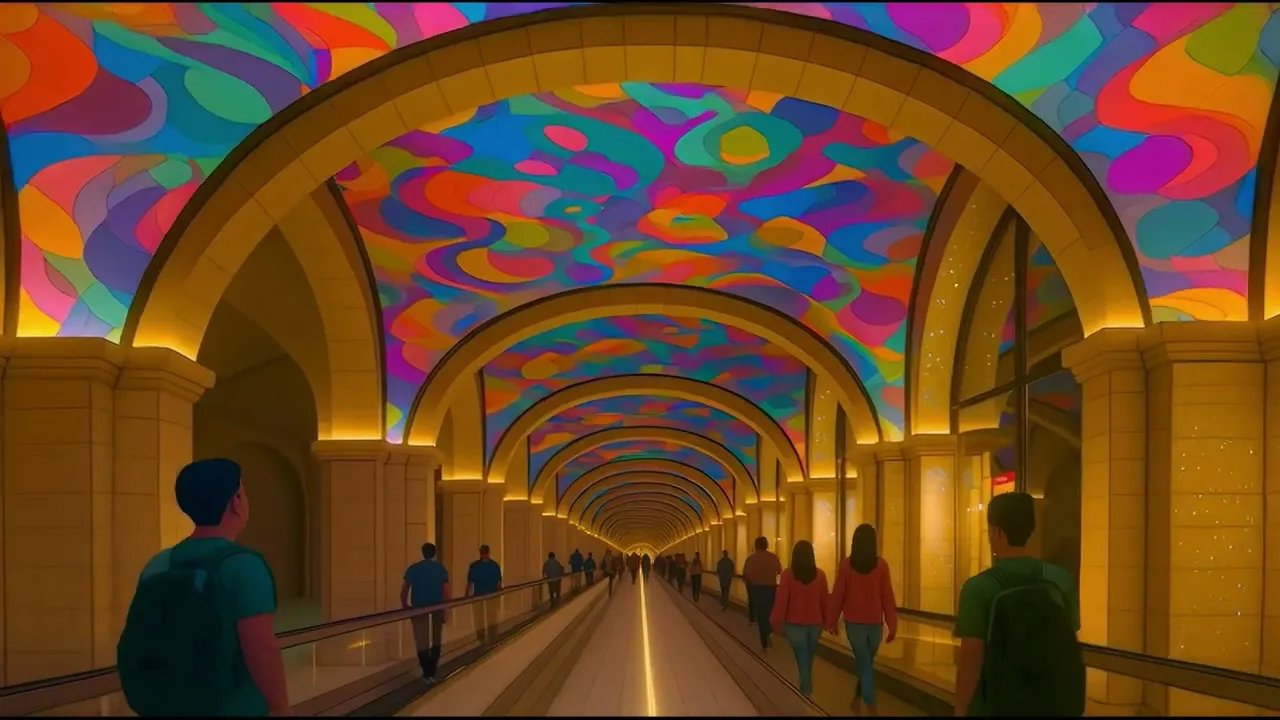
Heart of Westwood
Overview
Heart of Westwood is a future mobility concept developed during my internship at BMW Designworks, BMW Group’s global design consultancy, in Santa Monica. The project responds to a real shift happening in Westwood: the arrival of the Metro D-Line extension, growing congestion, and the added regional pressure expected around the 2028 Los Angeles Olympics.
Working in a team of three, I played a lead role across project direction, research, systems thinking, UX strategy, kiosk design, and final storytelling. We focused on a specific opportunity in Westwood: a high demand transit district with fragmented rider experiences, limited support, and an underused parking structure directly next to major future transit infrastructure.
Our proposal reimagines Parking Structure 32 as a people centered mobility hub. The concept connects metro, bus, bikes, pedestrians, parking, rider amenities, and digital assistance into one integrated experience. At the center of the user facing experience is an AI-powered kiosk assistant designed to help riders plan routes, access services, navigate transfers, and move through the hub with more confidence.
The final concept was presented to BMW Designworks global leadership along with guests from Los Angeles city government.
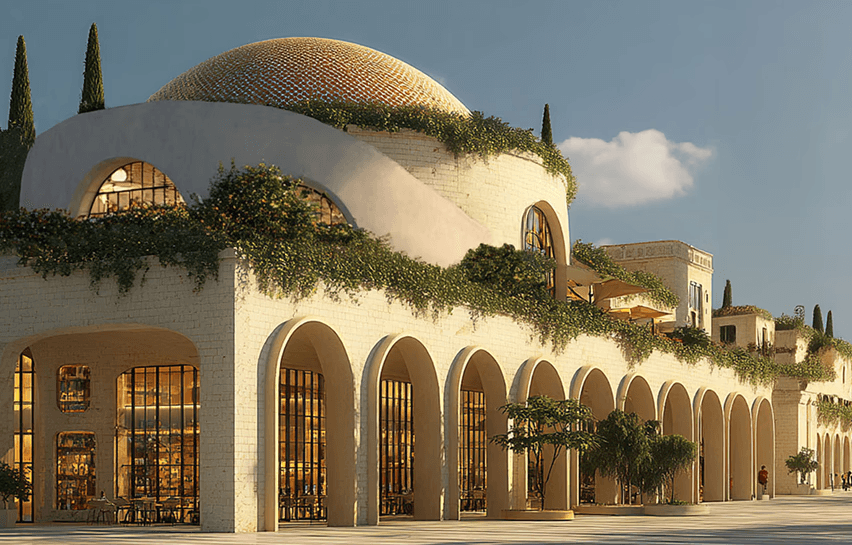
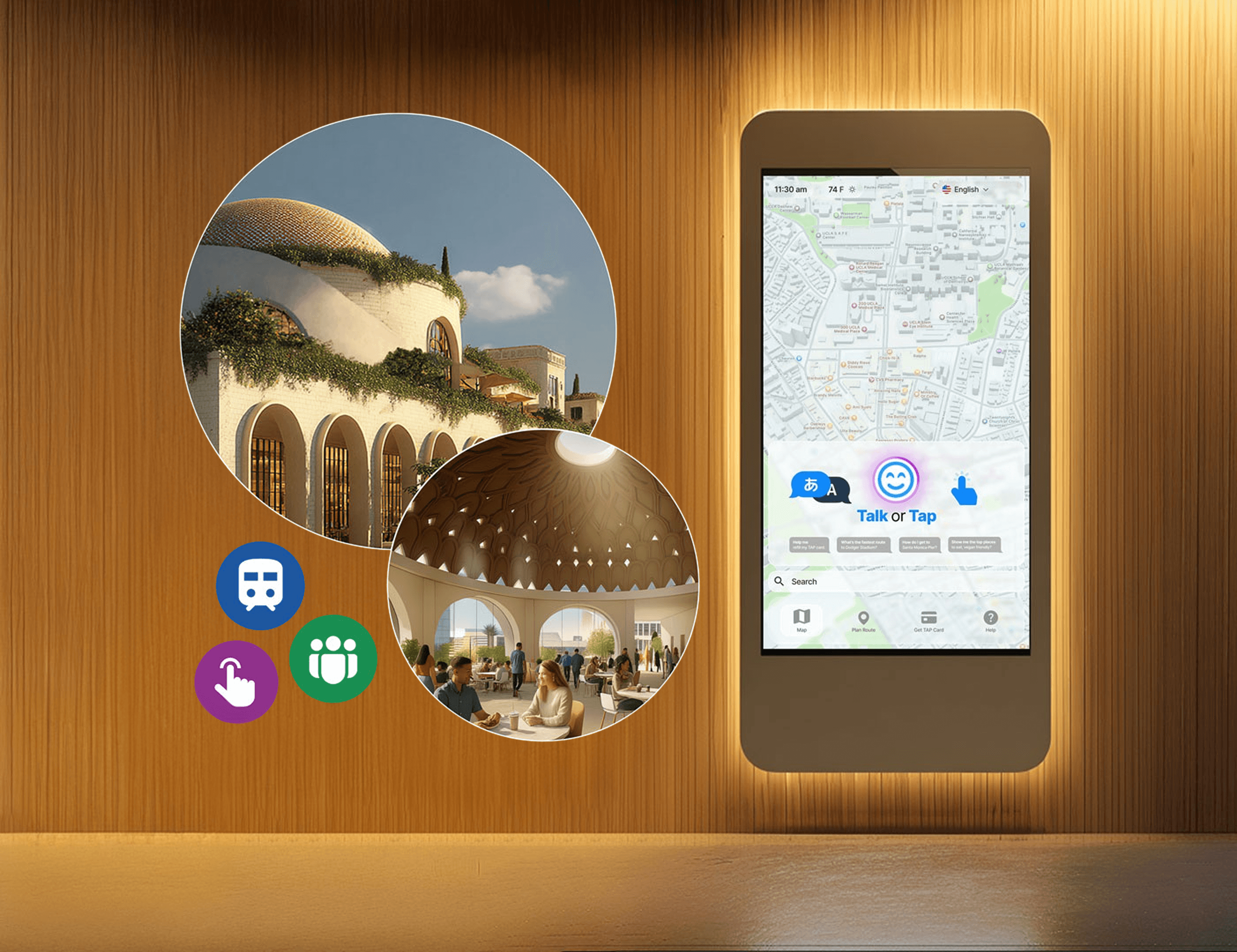
Exterior view of the Heart of Westwood, showing the proposed mobility hub’s architectural identity and public facing scale.
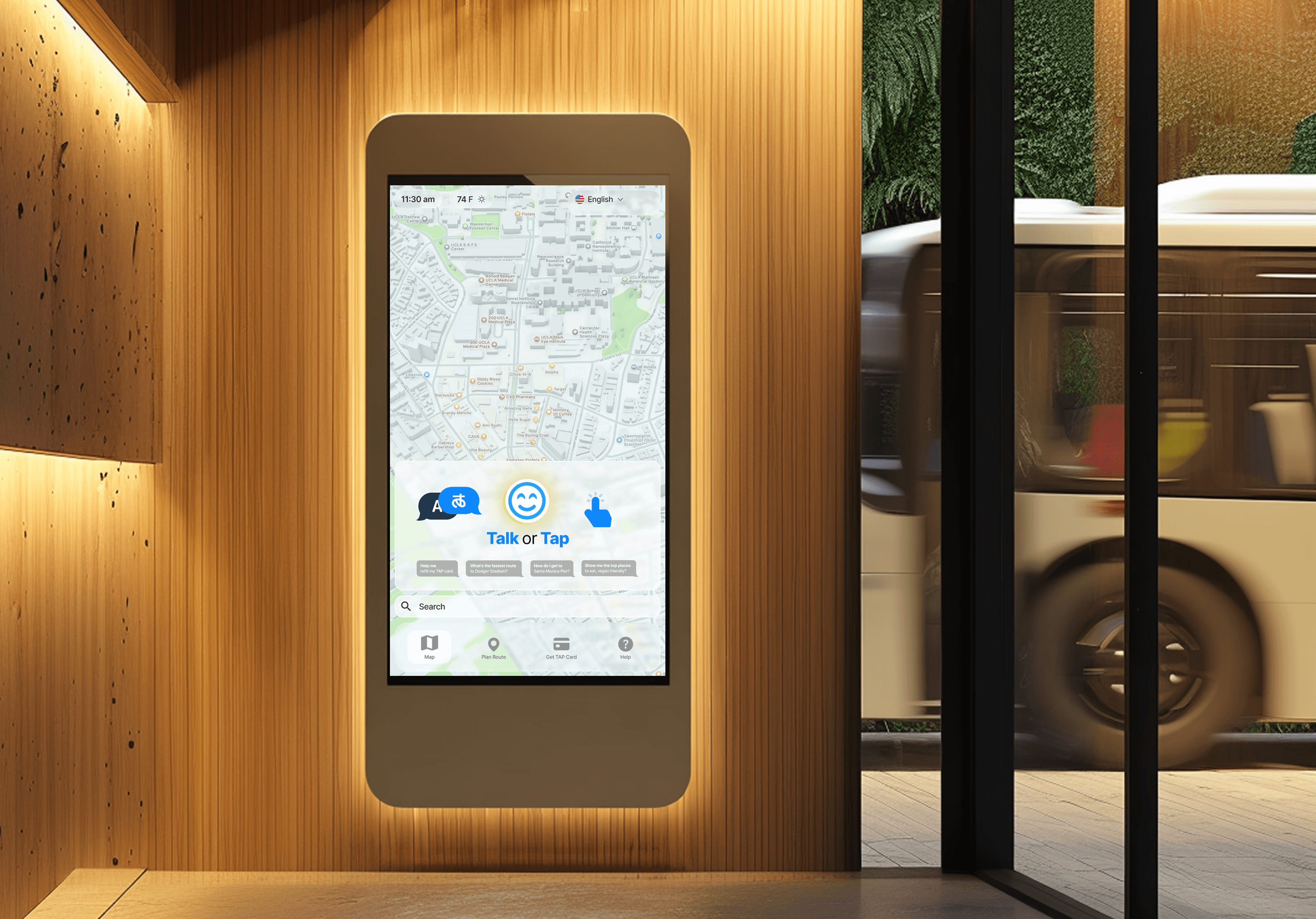
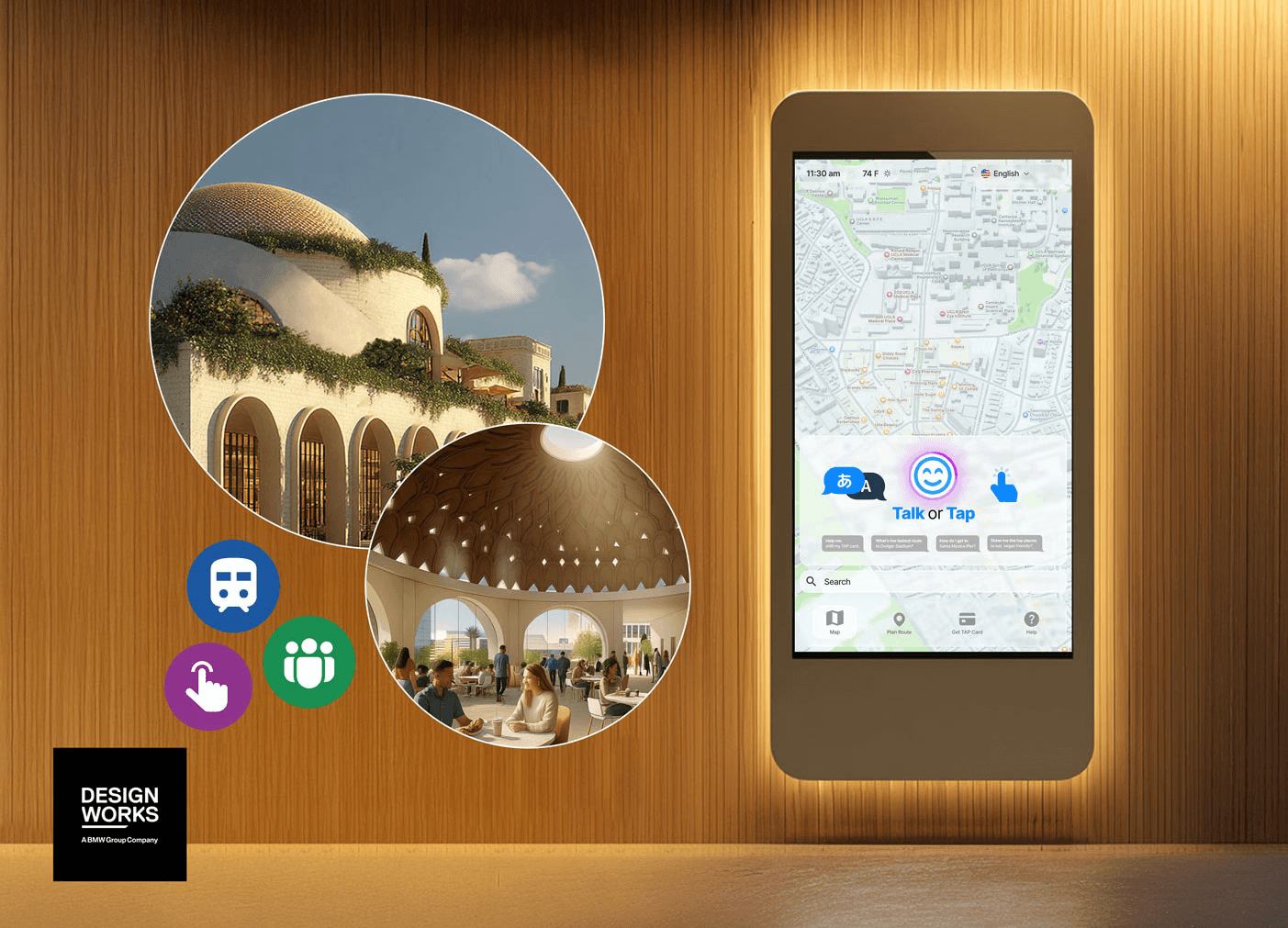
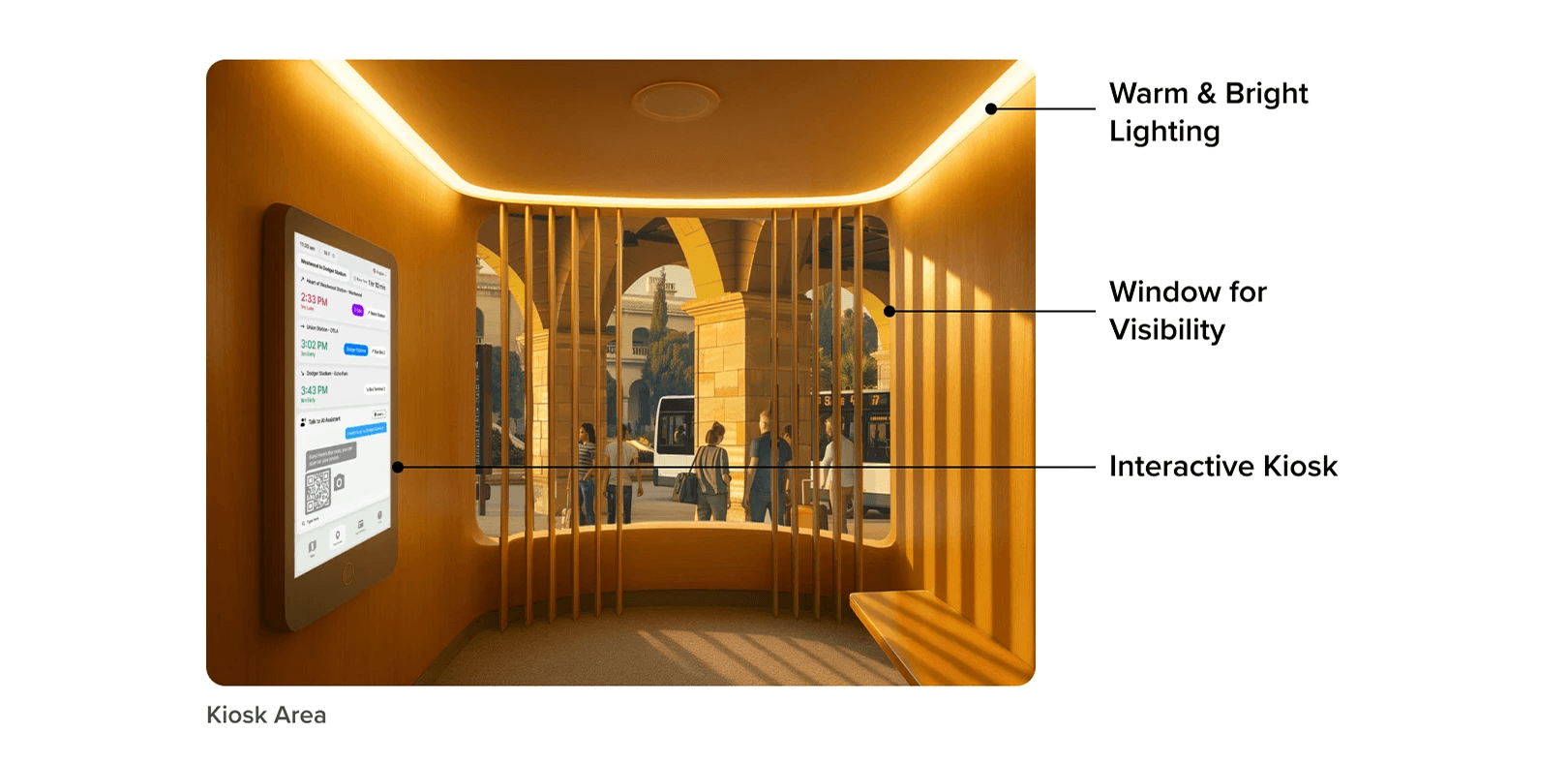
Render of the AI powered kiosk, designed to provide route planning, multilingual support, and transit assistance within the hub.
Context
During my summer internship at BMW Designworks, BMW Group’s global design consultancy, our team was asked to imagine a future mobility solution for Los Angeles. The brief encouraged us to think beyond small transportation improvements and explore what the city may need as new transit infrastructure comes online and global event pressure increases.
We chose Westwood because it already has a complex mobility environment. The district supports UCLA, major bus routes, medical centers, local businesses, residents, workers, students, and international visitors. It also faces heavy congestion, unpredictable surface transit, and a commuter experience that often feels fragmented and uncomfortable.
The future Metro D-Line station made Westwood especially important. Once completed, the D-Line will dramatically improve regional access to the area. That created a bigger design question for us: what happens around the station? A new rail stop can bring major value, but that value is limited if the surrounding environment does not help people transfer, wait, navigate, and connect to the rest of the neighborhood.
Directly next to the future D-Line station is Parking Structure 32, a large parking structure and surrounding site with major redevelopment potential. We saw that as the core opportunity. Instead of treating the site mainly as a place to store cars, we asked how it could become a true mobility asset for Westwood.
That framing shaped the entire project. Heart of Westwood is not only about improving transit aesthetics. It is about using a real piece of city infrastructure at a specific moment of change to create more public value, better rider support, and a stronger connection between different modes of movement.
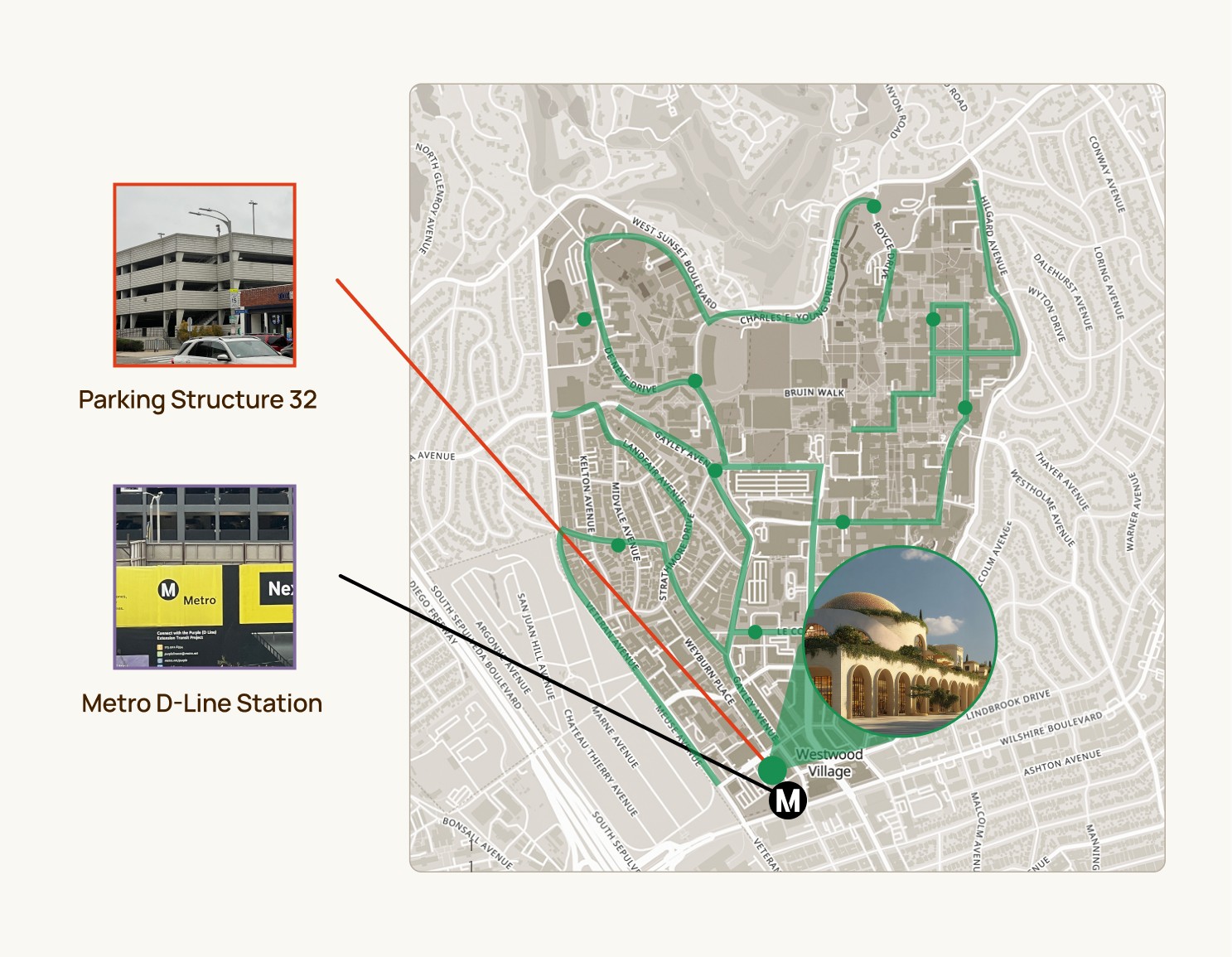
Location of the proposed hub in Westwood, where Parking Structure 32 is currently located.
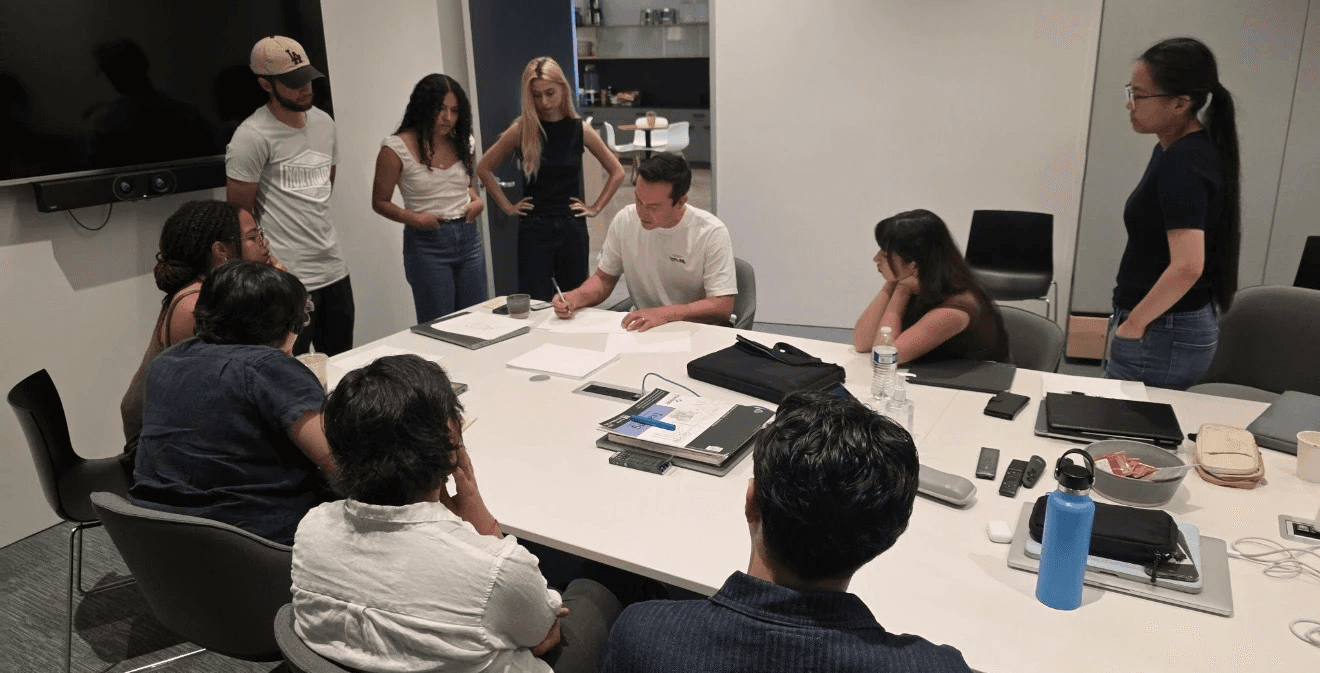
Ideating our mobility hub concept with BMW Designworks staff.
Research
We began by researching Westwood as both a current mobility bottleneck and a future high pressure transit zone. Through ethnographic observation, site analysis, precedent research, and secondary research, I helped identify the main issues shaping the commuter experience.
1. Heavy congestion
Westwood already experiences major traffic congestion, slow travel times, and unreliable surface transit flow. The area supports UCLA, dense commercial activity, major bus routes, medical traffic, and heavy local movement. With the 2028 Olympics approaching, those pressures are likely to intensify as more visitors and regional movement flow through the area.
2. Low rider comfort
The current rider experience can be physically uncomfortable and mentally draining. People wait on crowded sidewalks with limited shade, limited seating, and little protection from the environment. Transfers often happen in exposed, noisy, and confusing conditions. The experience does not offer much comfort, pause, or dignity for people who are not moving by car.
3. Weak support services
Transit support in the area does not fully serve a diverse and global user base. Existing kiosks and support systems are limited, especially for first time riders, international visitors, non-English speakers, and people who are already uncertain about where to go. Static signage and traditional kiosks do not always provide enough help when someone needs route planning, service guidance, ticketing support, or transfer confidence.
4. Underused site potential
One of the most important findings was spatial. Parking Structure 32 sits directly next to the future D-Line station, but it currently functions as a large car storage asset on extremely valuable land. As the D-Line increases transit access and Westwood becomes more connected, keeping that site mostly dedicated to above ground parking represents a major missed opportunity.
This became the key research insight: the strongest opportunity was not only to solve rider pain points, but to use the future D-Line as a trigger for rethinking the land around it. The site could support a much larger mobility ecosystem if it connected parking, transit, bus access, micromobility, pedestrian movement, waiting, services, and digital support into one place.
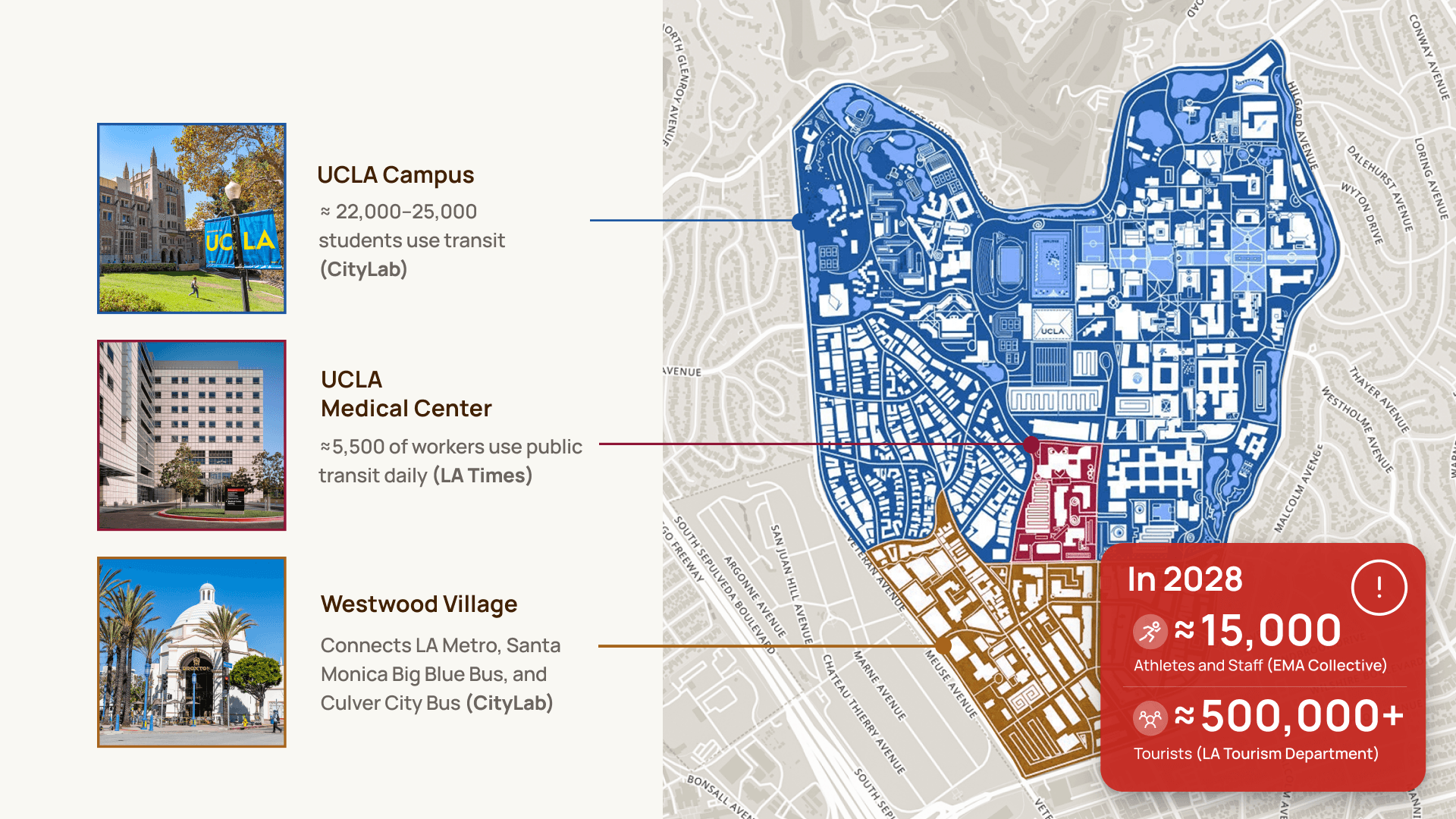
Major user groups and destinations that make Westwood a high demand mobility district, especially looking ahead to 2028.
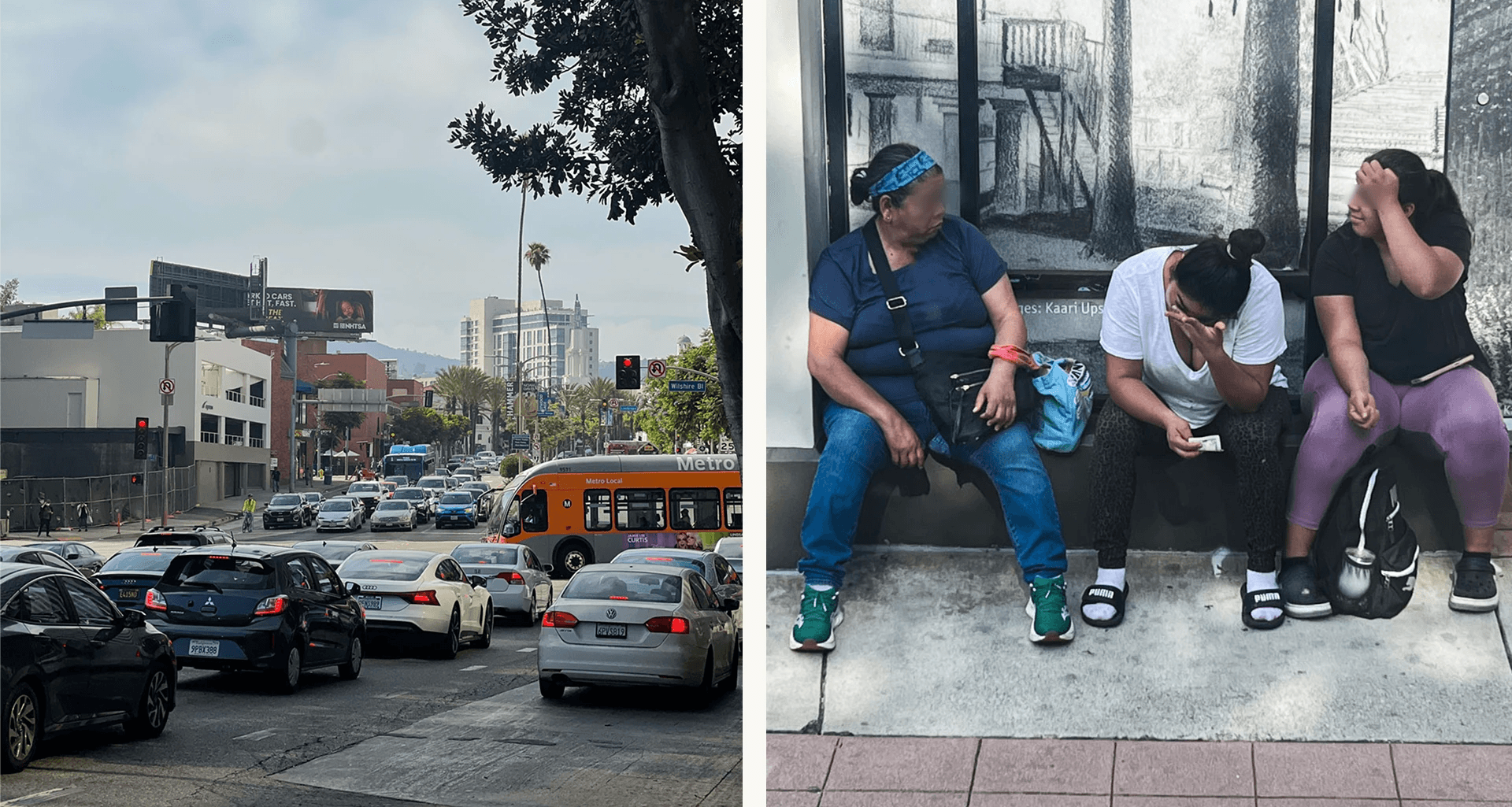
Field research documenting two core mobility issues in Westwood: severe congestion and limited comfort for people waiting on foot.
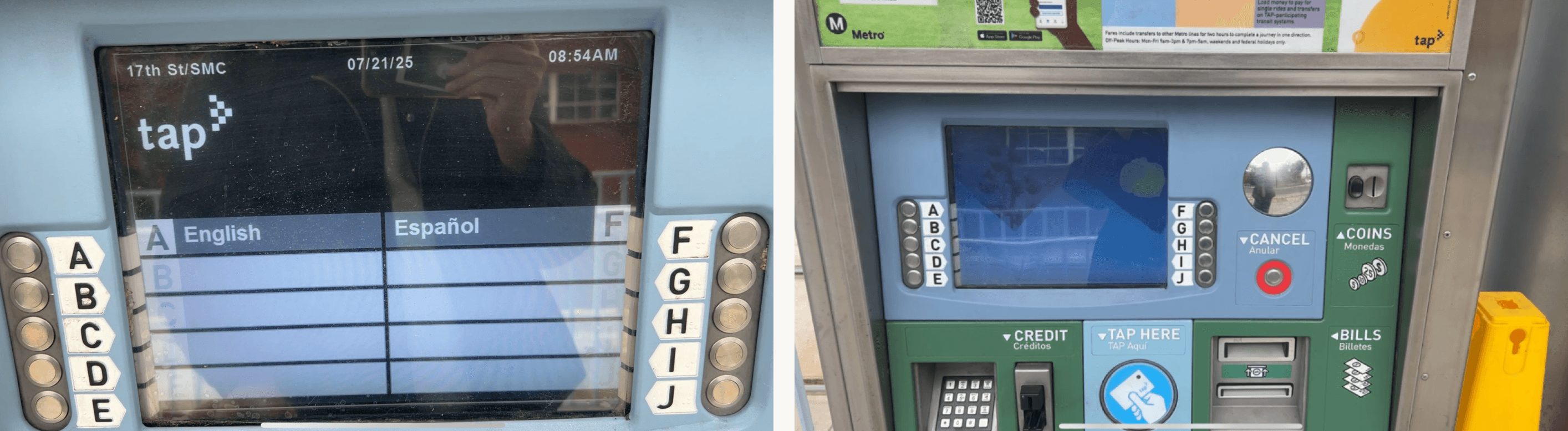
The existing TAP kiosk interfaces, which currently have poor usability. Along with support for only two languages.
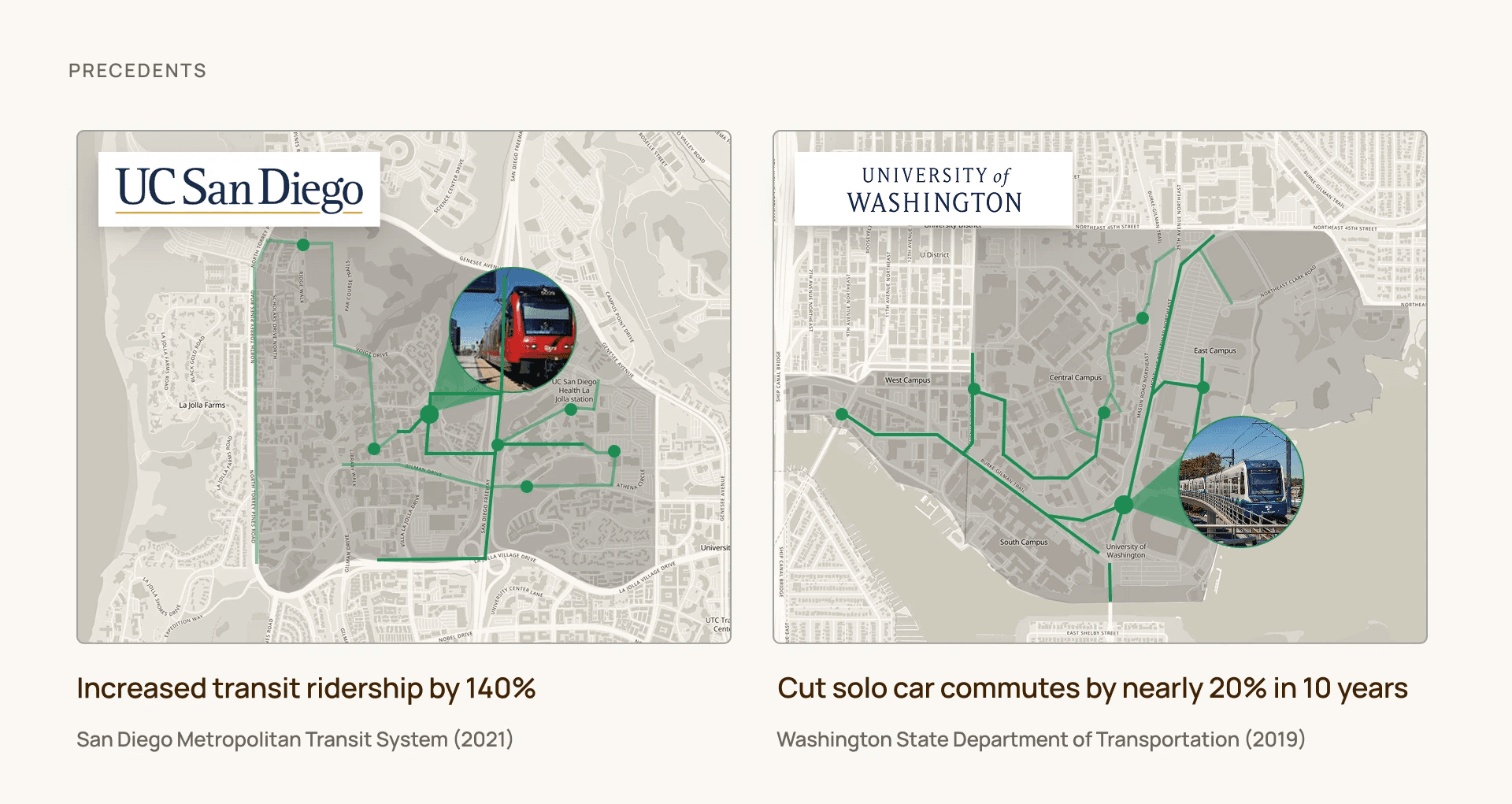
University mobility systems that informed the project, showing how peer cities improved transit ridership and reduced car dependence.
Process
We started by studying how people currently move through Westwood. During field research, we documented congestion, exposed waiting conditions, unclear transfer points, and gaps in rider support. Through observation, site analysis, and precedent research, I helped synthesize those findings into a broader systems problem: Westwood’s mobility experience was fragmented, and the surrounding infrastructure was not prepared for the future pressure of the D-Line and the 2028 Olympics.
From there, we reframed the opportunity around Parking Structure 32. Instead of creating a generic transit improvement, we focused on a specific site directly next to the future Metro D-Line station. That made the project more grounded. The question became: how could this existing structure become a stronger mobility asset for the neighborhood?
I helped shape the concept across both physical and digital layers. On the spatial side, we organized the hub into three levels: underground, ground level, and terrace. Each level served a different part of the commuter journey, including parking, D-Line access, bus transfers, entry points, waiting, rest, dining, and micromobility access.
On the digital side, I played a major role in defining the kiosk experience as the rider facing support layer inside the larger hub. The kiosk needed to do more than display information. It needed to help people make decisions, plan trips, understand routes, access services, and feel less lost inside a complex transit environment.
A major part of my contribution was keeping the concept connected as one system. The physical hub, the kiosk UX, the circulation plan, the service logic, the architectural language, and the final presentation all needed to support the same idea: a mobility hub that makes movement through Westwood easier, clearer, and more comfortable.
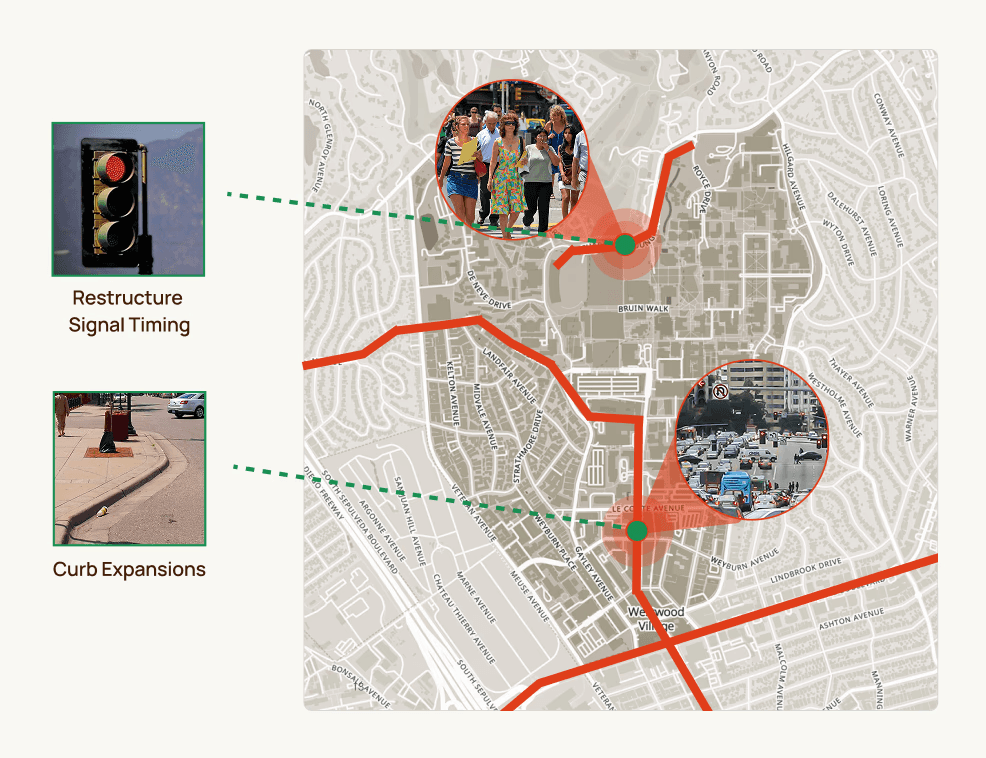
Proposed street level interventions, including signal timing updates and curb expansions to improve flow and safety.
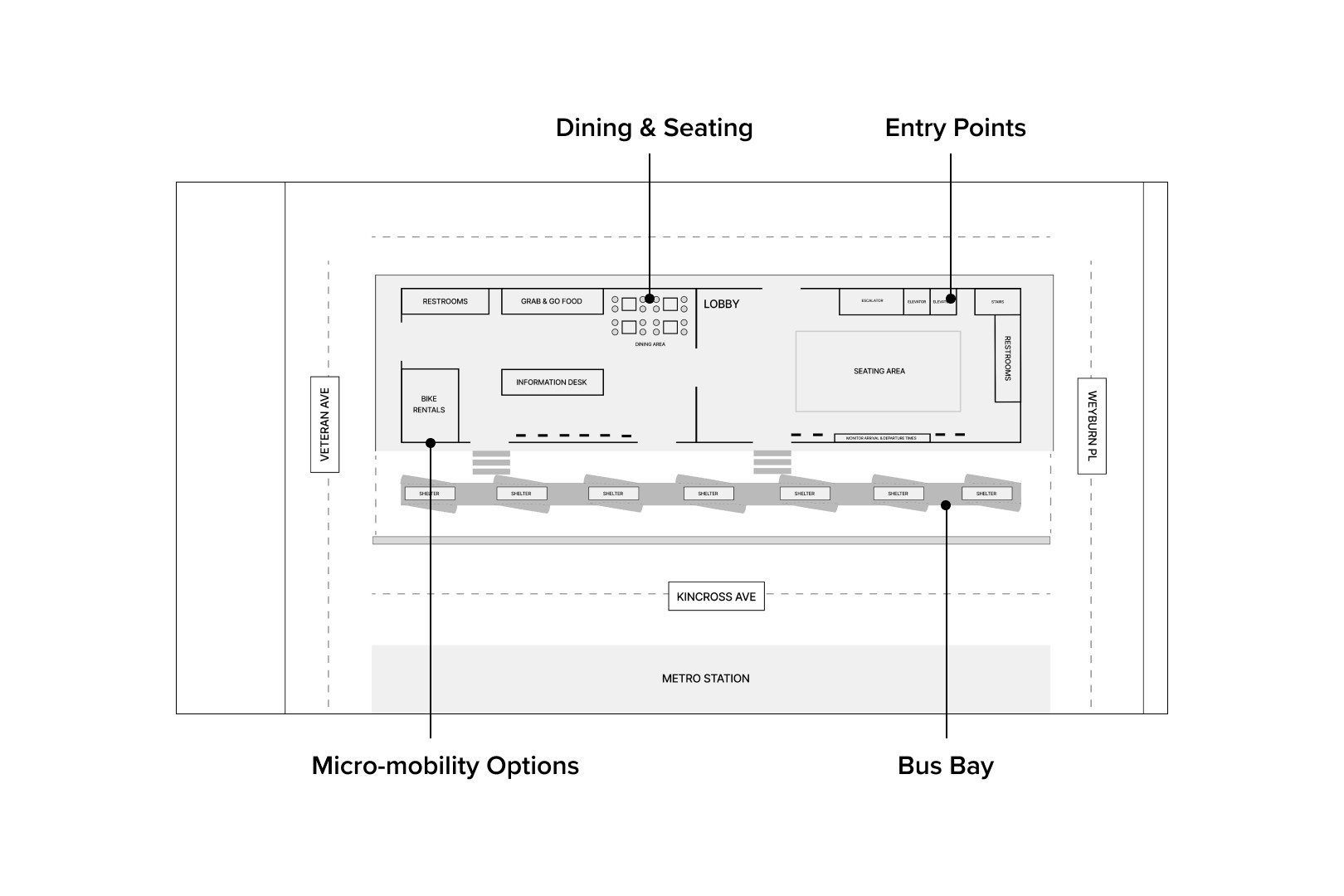
A floor plan of the ground level, outlining key program elements such as the bus bay, micro-mobility access, dining, and entry points.
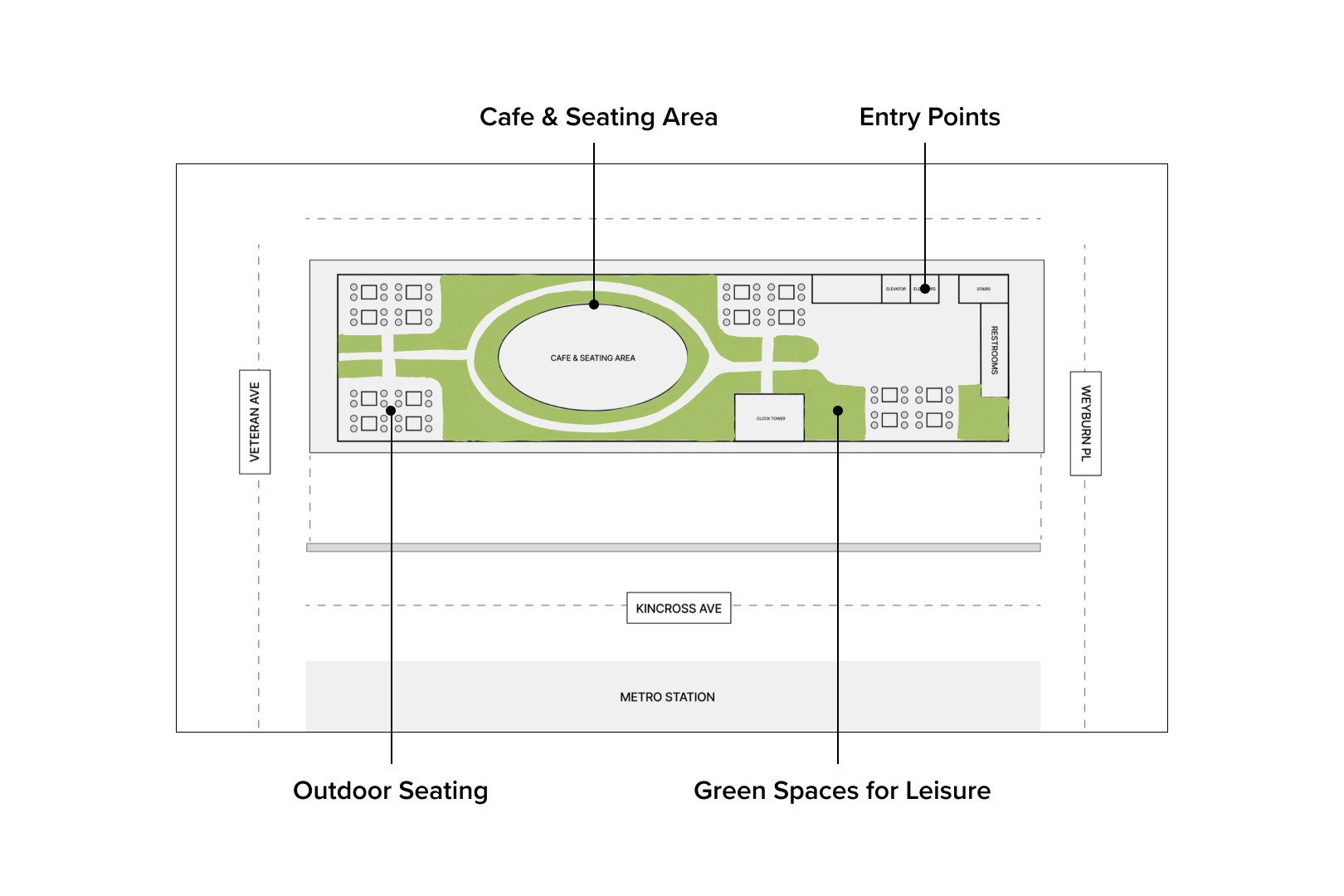
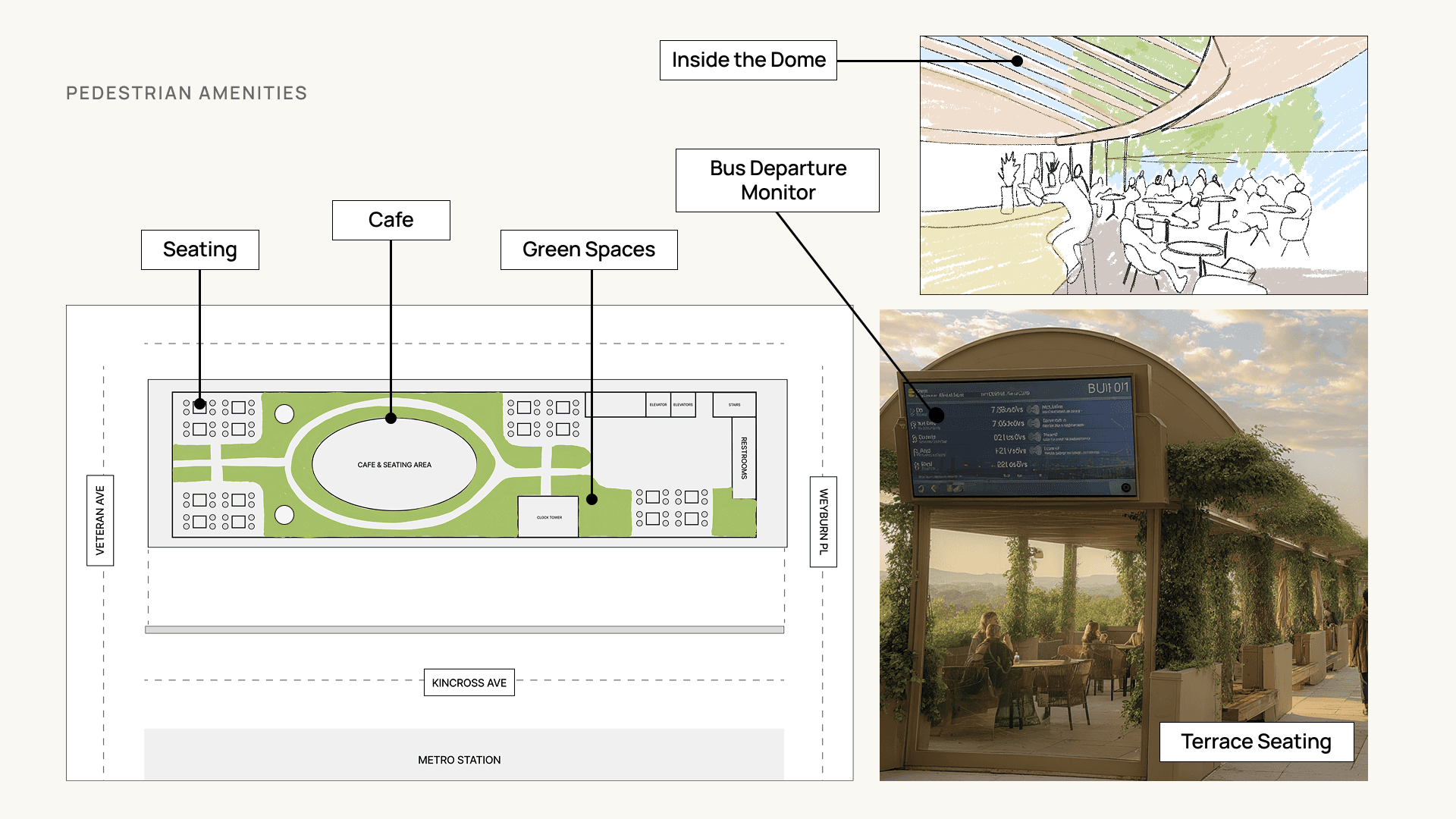
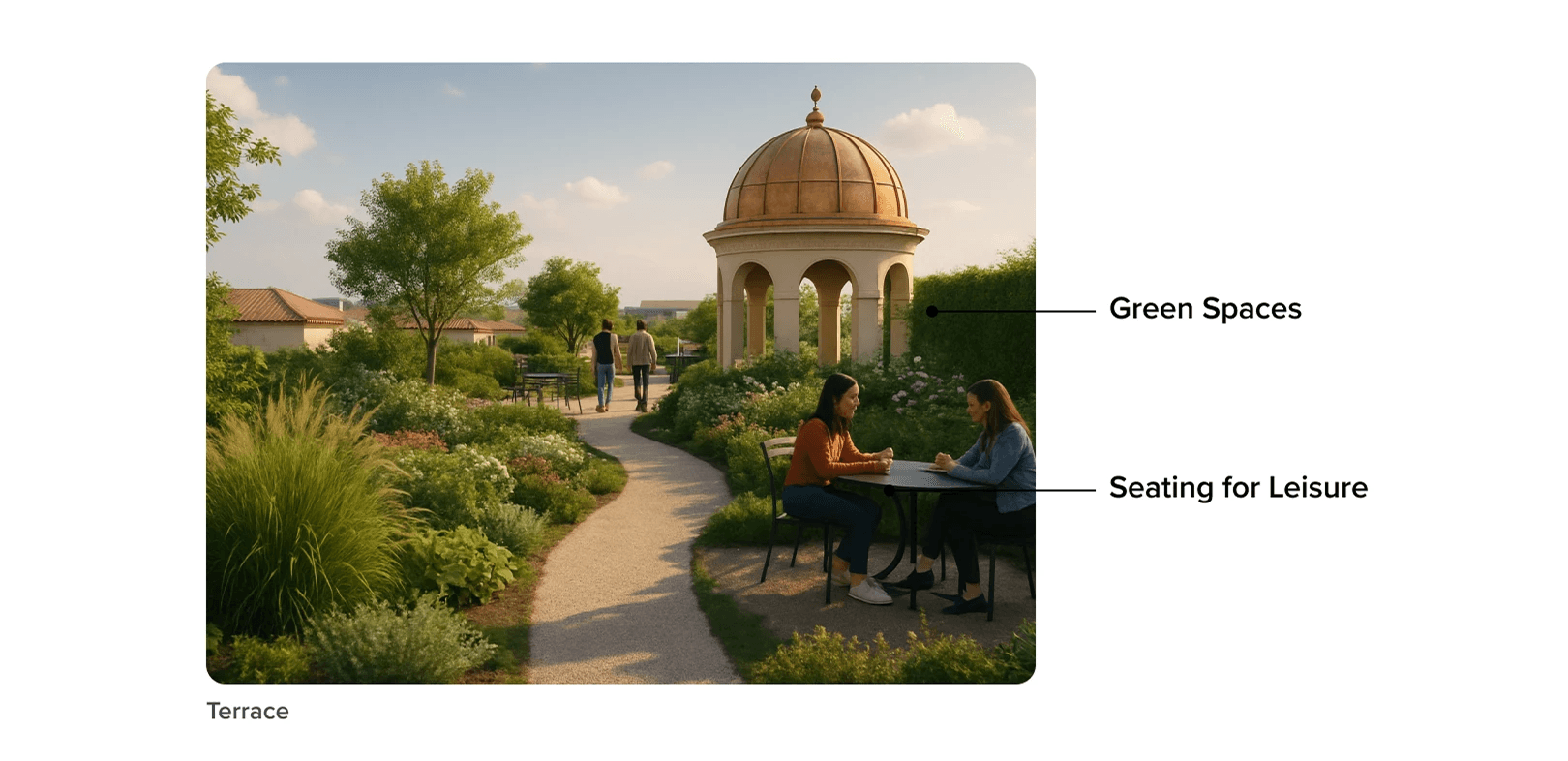
A floor plan of the terrace level, showing how seating, greenery, and shared gathering spaces create a calmer place to rest within the hub.
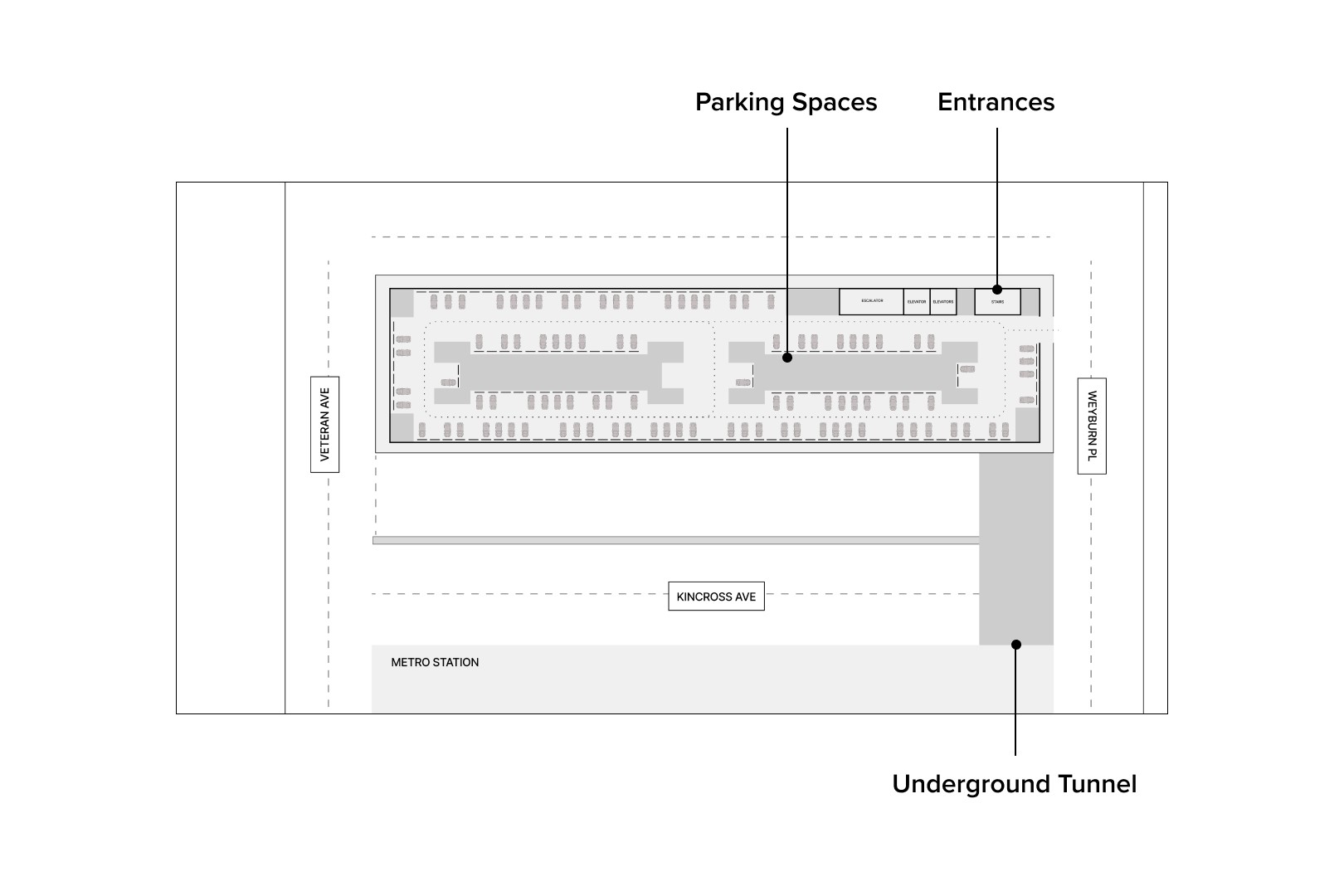
A floor plan of the underground level, showing parking access and the direct tunnel connection to the future Metro D-Line station.
Strategy
Our strategy was based on one main belief: future mobility in Westwood should work as an integrated system, not as a set of disconnected transportation fixes. Three strategic moves shaped the concept.
1. Repurpose existing infrastructure
Rather than proposing a completely new site, we focused on Parking Structure 32, a large existing structure directly beside the future D-Line station. That made the concept more relevant to Westwood’s actual future and more believable as a long-term redevelopment opportunity.
The concept preserves the value of parking where it is still needed, but moves it underground. This frees the rest of the site to support transit access, public space, waiting areas, rider services, micromobility, and neighborhood facing amenities. The result is a higher value use of the land without ignoring the role cars still play in Los Angeles.
2. Use the D-Line as a force multiplier
The D-Line will bring major regional transportation value to Westwood, but the area around the station will determine how useful that investment feels day to day. Our concept extends the value of the D-Line by turning the adjacent site into a full transfer and support ecosystem.
This was a major strategic point. The D-Line becomes more powerful when it is connected to buses, bikes, pedestrians, parking, real time information, amenities, and service support in one coordinated place. Heart of Westwood is designed to make the station feel like part of a larger mobility network instead of an isolated stop.
3. Design for friction reduction
The hub and kiosk were both designed around reducing real commuter friction. That included painful transfers, unclear wayfinding, poor waiting conditions, limited language support, uncertainty around routes, and the lack of immediate help when riders do not know what to do next.
This is where the AI kiosk became important. We did not treat AI as a visual add on. We treated it as a practical support layer for public infrastructure. The kiosk acts as a smart transit concierge that helps riders complete tasks, understand their options, and move through the system with more confidence.
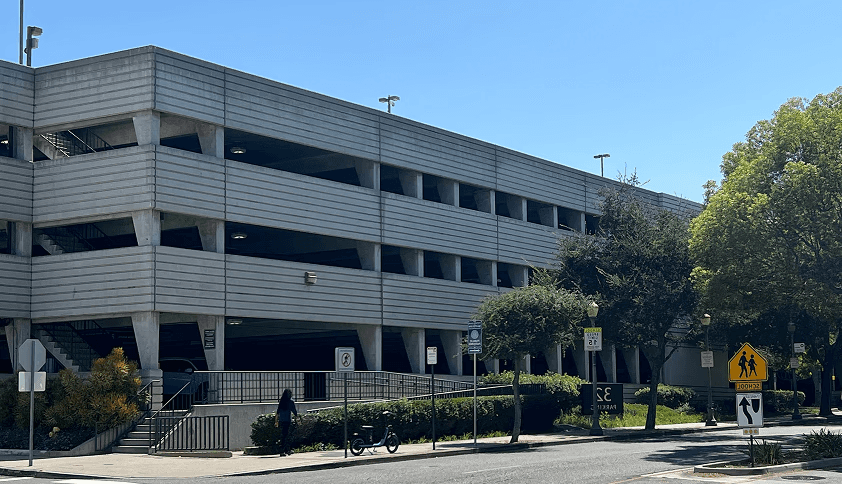
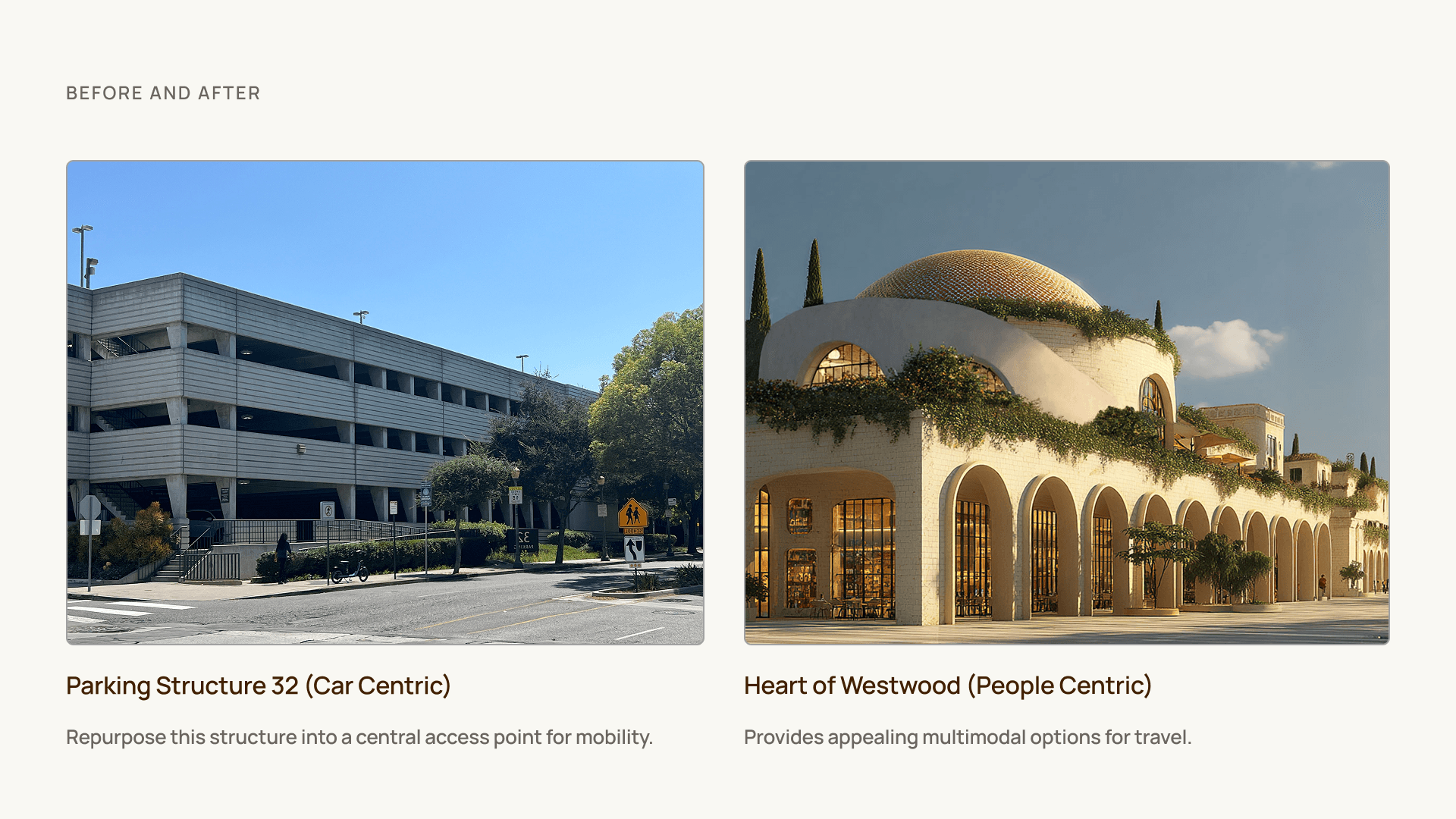
The current Parking Structure 32 site, which became the basis for reimagining the area as a future multimodal mobility hub.
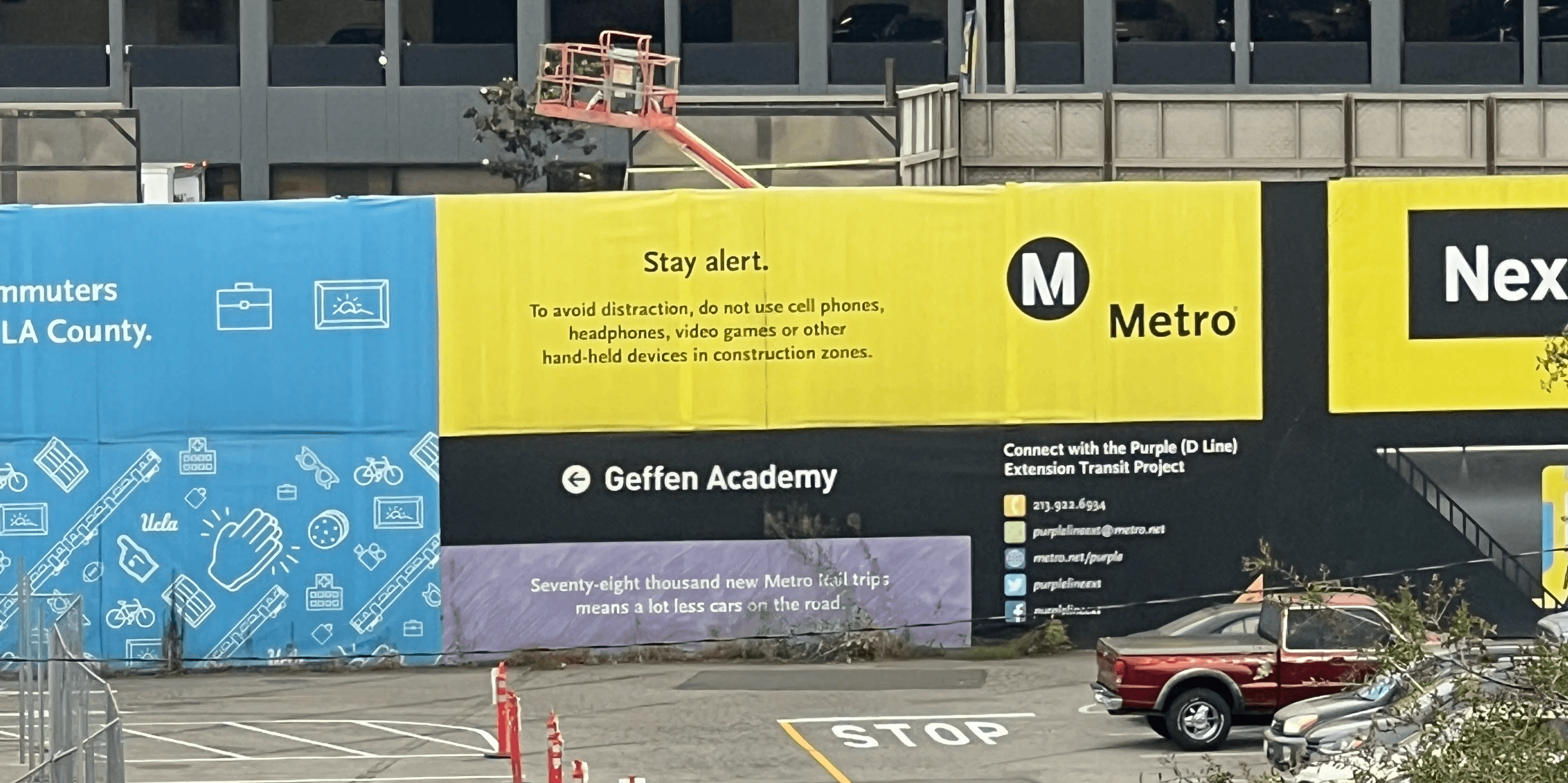
The future Metro D-Line station under construction next to the proposed hub site, showing the real infrastructure opportunity shaping the concept.
Validation
Research backed alignment
The final concept directly responded to the main issues we identified in Westwood: congestion, limited comfort, fragmented transfers, weak rider support, and underused land beside future transit infrastructure. Each major design move connects back to a specific research finding.
The underground level supports the D-Line connection and parking strategy. The ground level supports bus access, movement, services, and circulation. The terrace responds to the need for more comfortable waiting and rest. The kiosk responds to the need for clearer guidance, multilingual support, and real time assistance.
Site credibility
The proposal was grounded in a real location with a real transit investment already underway. Centering the project on Parking Structure 32 and the future Metro D-Line station helped the concept feel strategically realistic instead of speculative for its own sake.
The timing also made the concept more believable. Westwood is already a high demand district, and the 2028 Olympics will place more pressure on Los Angeles mobility systems. Designing around a site next to a new rail station gave the project a clear reason to exist now.
Integrated system thinking
One of the strongest signs of validation was that the concept worked across multiple layers at once. The land use strategy, circulation planning, rider amenities, architectural identity, and kiosk experience all reinforced each other.
The kiosk was especially important because it translated the larger mobility vision into a direct user interaction. It showed how the system would actually help a person who is trying to find a route, transfer modes, use TAP services, get language support, or understand what is available inside the hub.
Leadership presentation
At the end of the internship, we presented the full concept to BMW Designworks global leadership along with guests from Los Angeles city government. That presentation acted as an important form of validation because the work had to stand up as a serious future mobility proposal in front of experienced design and city facing stakeholders.
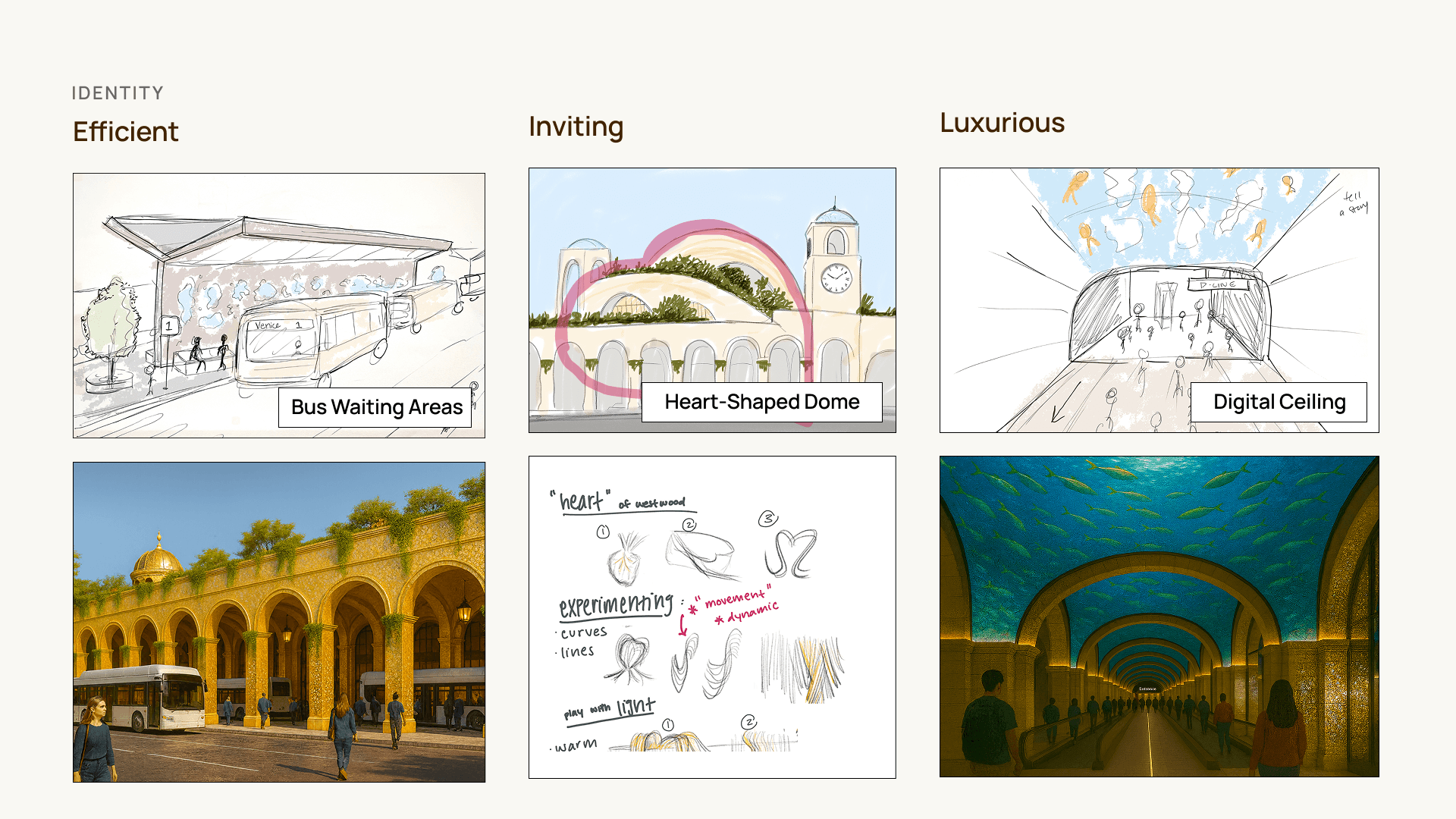
Early sketches and visual studies used to define the hub’s architectural character around efficiency, warmth, and a more elevated commuter experience.
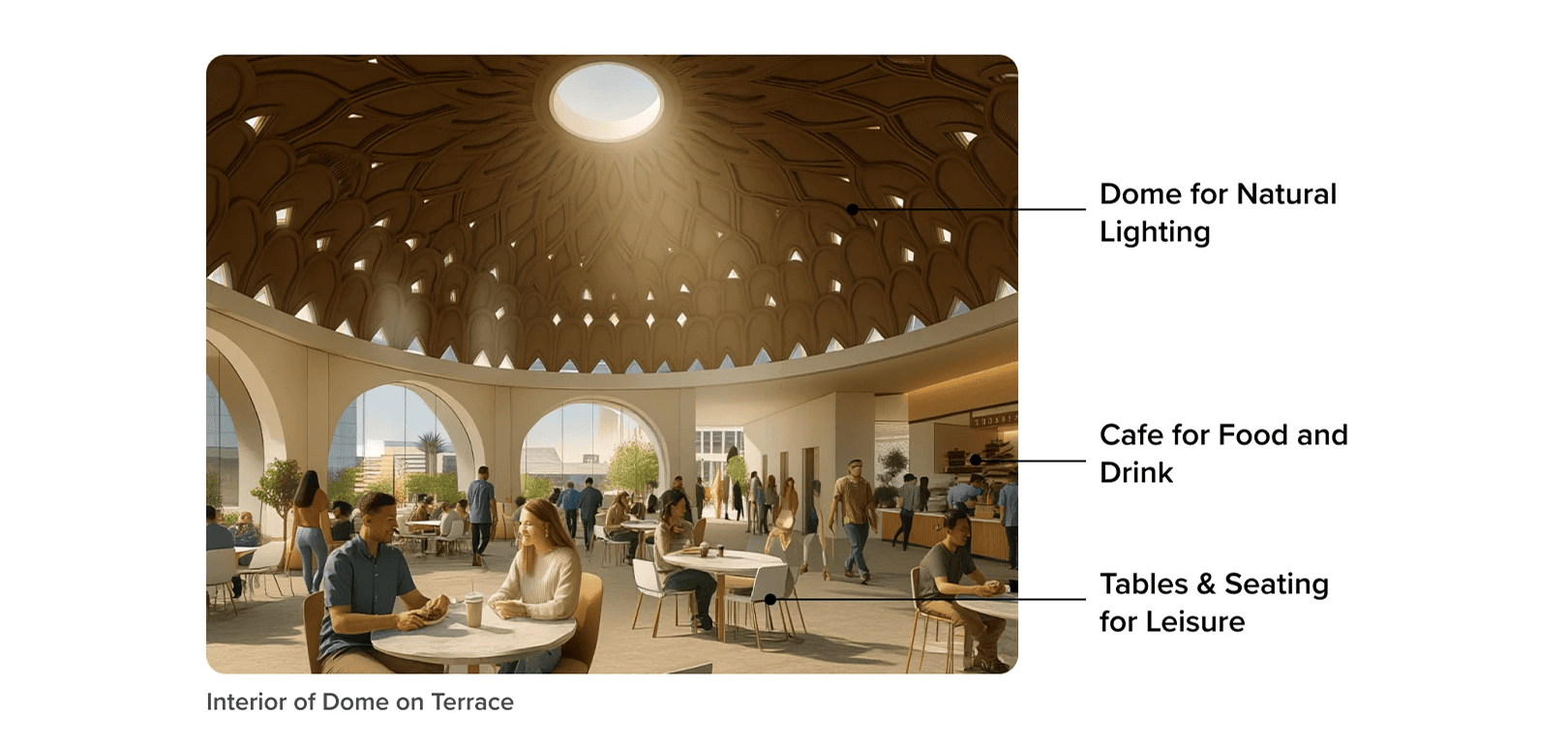
Quality seating, green space, café amenities, and real time transit information could make waiting feel more comfortable and useful.
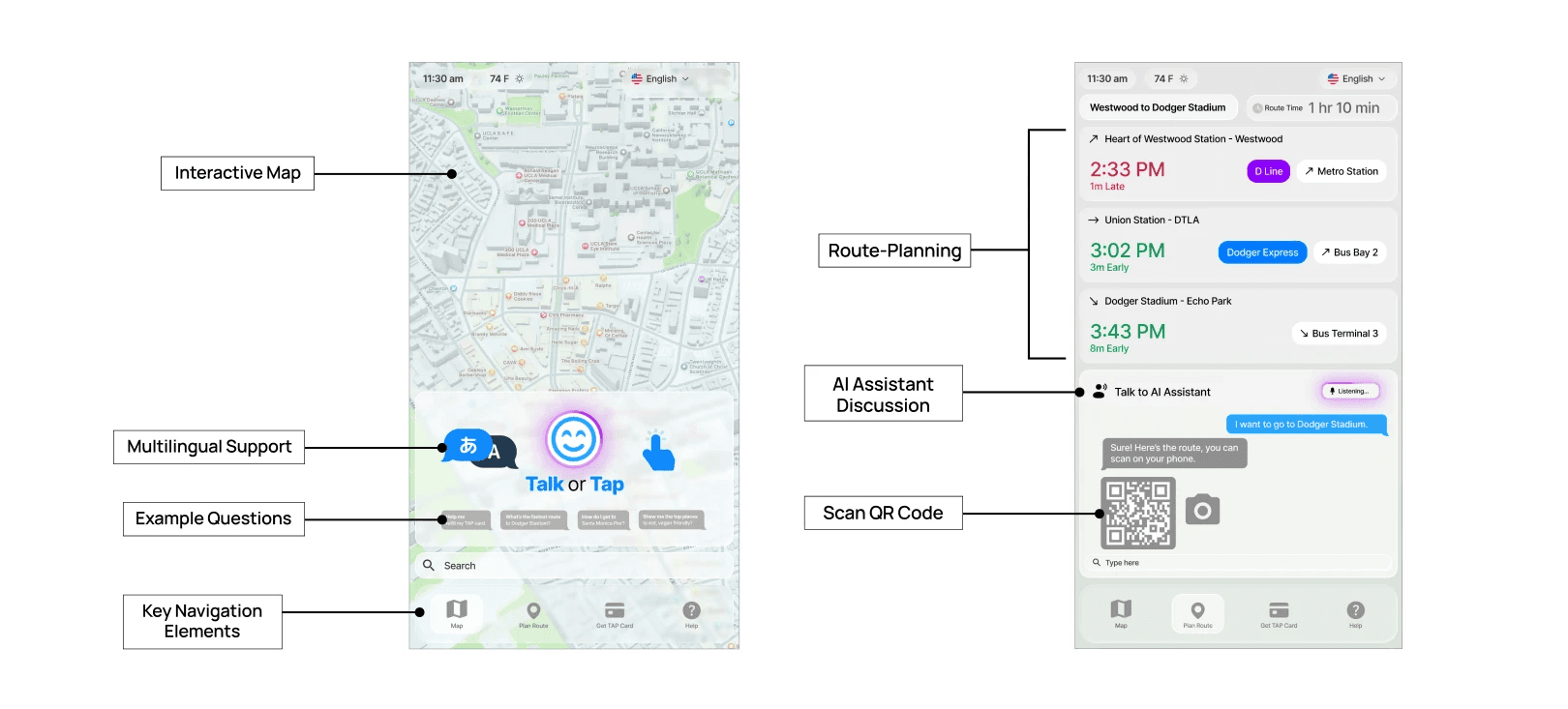
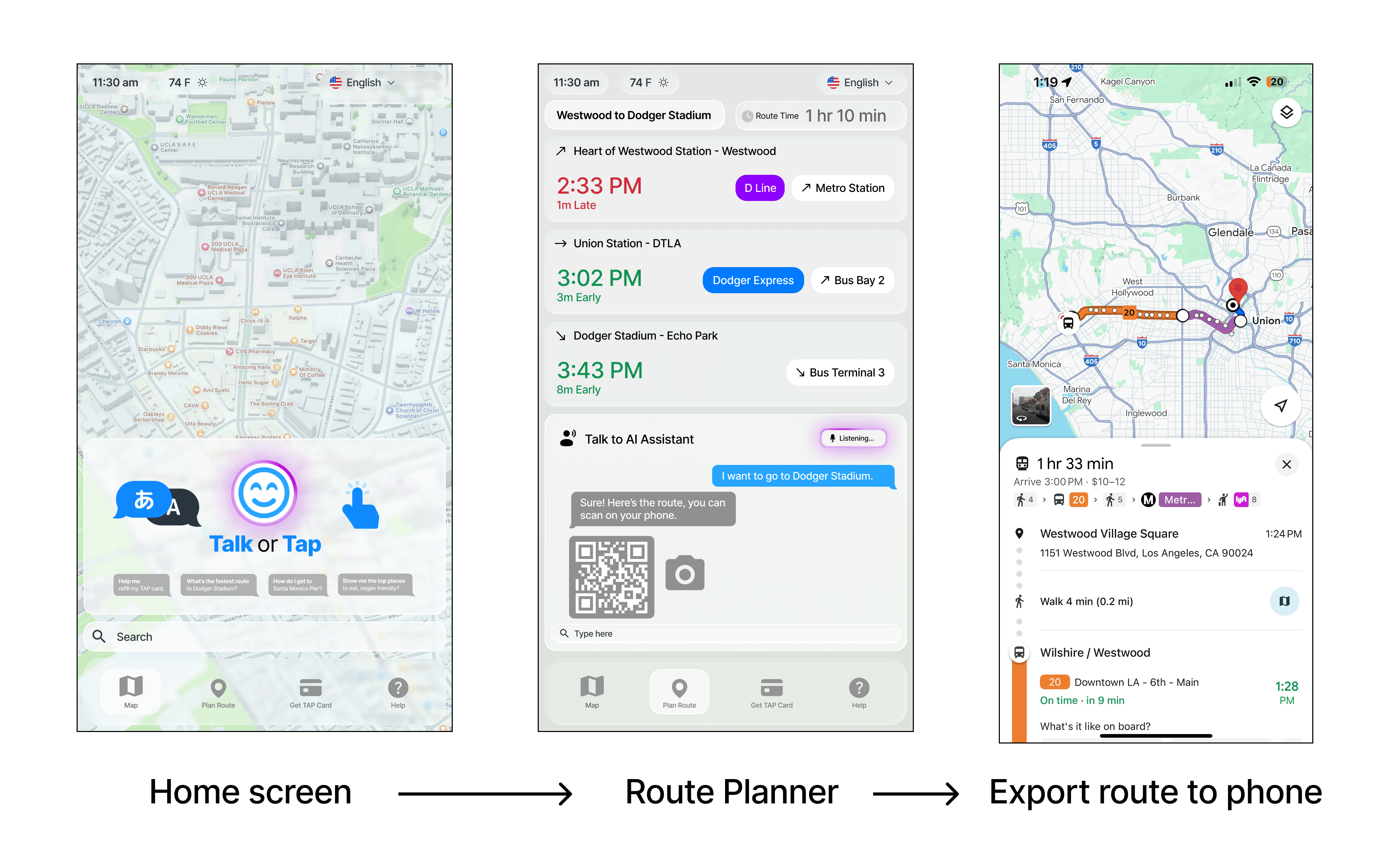
Screens showing the kiosk’s core experience, including multilingual access, route planning, AI assistance, and QR handoff to a phone.
Solution
We designed Heart of Westwood as a multimodal mobility hub that transforms a car centric site into a connected, people centered transit destination.
Instead of leaving the site dominated by above ground parking, the concept reorganizes it around mobility, comfort, and support. Parking is consolidated underground, while the rest of the structure and surrounding site are repurposed into a layered commuter experience connected directly to the future Metro D-Line and nearby bus infrastructure.
The hub is organized into three levels.
Underground
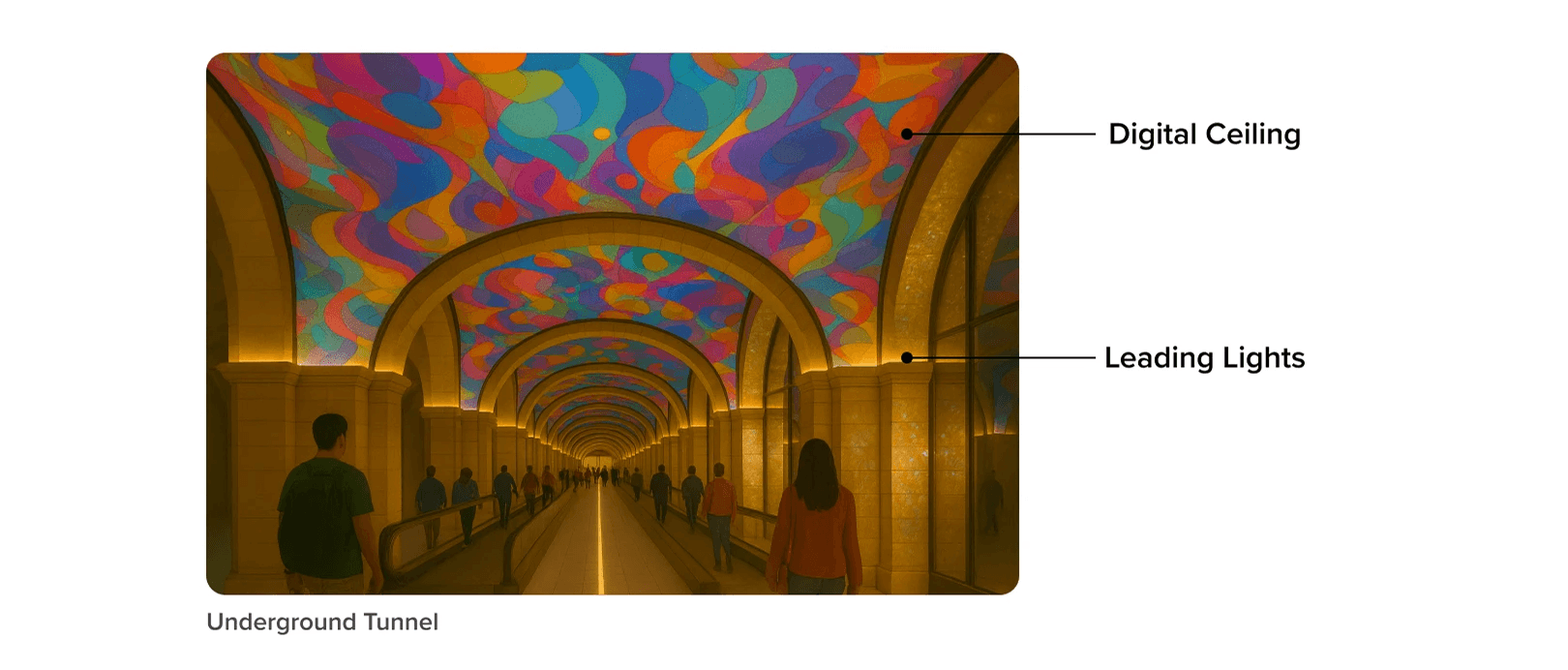
The underground level retains parking while adding a direct tunnel connection to the Metro D-Line station. This creates a more seamless relationship between driving, walking, and rail. It also allows the site to preserve parking capacity while freeing the upper levels for higher value public and mobility uses.
Ground Level
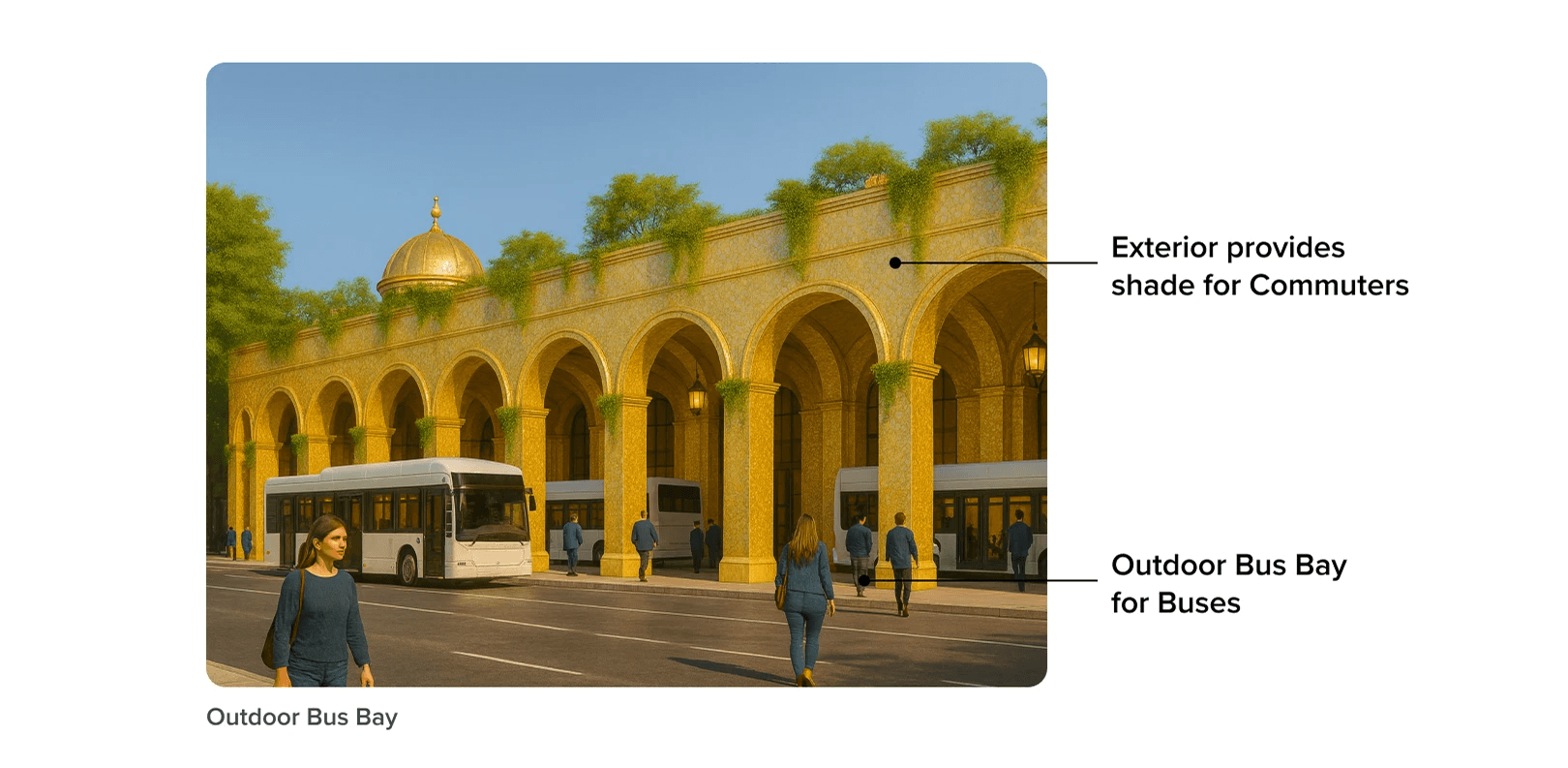
The ground level serves as the main circulation and transit layer. It includes bus access, entry points, waiting areas, micromobility connections, dining, rider support spaces, and clear paths through the hub. This level is designed to make transfers easier and reduce the confusion that often comes with moving between modes.
Terrace
The terrace provides a calmer upper level environment with seating, greenery, rest areas, and café space. Instead of treating waiting as wasted time, the terrace turns it into a more restorative and useful part of the commuter experience.
The visual language draws from Mediterranean Revival architecture, helping the concept feel more rooted in Westwood instead of looking like a generic transit center. The goal was to create a space that felt civic, warm, and connected to the neighborhood while still supporting future mobility needs.
Key Features
1. Multimodal integration
The hub brings together metro, bus, bike, pedestrian movement, parking, micromobility, and rider services in one coordinated system. Instead of scattered transfers and disconnected infrastructure, users move through a more unified mobility experience.
2. Direct D-Line connection
A direct underground connection links the hub to the future Metro D-Line station. This increases the usefulness of the new rail line by making transfers easier and tying the station into a broader mobility destination.
3. Redevelopment of an underused site
Parking Structure 32 is a large structure beside a major new transit investment. Keeping it mainly as above ground parking would miss the larger potential of the site. By moving parking underground and repurposing the rest of the space, the concept increases the site’s value to the neighborhood.
4. Improved rider comfort
The concept adds shade, seating, pause points, greenery, café space, and more comfortable waiting areas. Comfort was treated as core infrastructure, not a decorative layer. The goal was to make transit feel more humane for people who are waiting, transferring, or navigating the area on foot.
5. Clearer movement and wayfinding
The physical layout is designed to reduce confusion. Clearer circulation, readable access points, organized transfer areas, and visible support spaces help users understand where to go without relying only on signage.
6. Agentic AI kiosk assistant
The kiosk was one of the most important parts of the project and one of the areas where I contributed most heavily.
The kiosk is designed as an agentic AI transit assistant, not a static information screen. It helps riders complete tasks, compare options, understand routes, and move through the hub more confidently.
Core kiosk capabilities include:
route planning based on destination and preferred mode
real time arrival and departure information
transfer guidance between bus, metro, walking, and micromobility routes
multilingual support for a diverse and global rider population
voice first interaction to reduce friction and improve accessibility
TAP card services and transit account support
ticketing and trip assistance
service discovery inside the hub
contextual help for first time visitors
guidance for users who do not know where to go or what to do next
QR code handoff, allowing trip information to transfer to a phone
example prompts and guided interactions to make the system feel approachable
This was the key UX layer of the concept. The kiosk acts more like a smart transit concierge than a traditional kiosk. Its purpose is to reduce uncertainty, especially for people who are unfamiliar with the area, navigating in another language, or anxious about transfers.
7. Support spaces that feel safe and usable
The kiosk areas were designed to feel visible, calm, and supportive. Natural lighting, open sight lines, and clear placement help make assistance feel accessible without making users feel exposed or isolated.
8. Local architectural grounding
The concept draws from Westwood’s architectural character, especially Mediterranean Revival influences. This helped the hub feel more like a civic place within the neighborhood rather than a generic transportation facility.
A flow showing how the kiosk helps users intuitively plan their route.
Results
The final outcome was a fully developed future mobility concept expressed across research, strategy, spatial design, service design, UX, and visual storytelling.
Deliverables included:
a clearly framed mobility problem tied to real Westwood conditions
a research backed strategic argument for repurposing Parking Structure 32
a multimodal hub concept integrated with the future D-Line station
a three level spatial strategy for underground, ground, and terrace experiences
floor plans showing circulation, amenities, parking, D-Line access, and program areas
visual studies defining the architectural character of the hub
kiosk UX concepts and interface screens
AI assisted transit service flows
high fidelity presentation materials communicating the system end to end
One of the strongest outcomes was that the project did not stay at the level of broad urban design language. It translated the larger mobility vision into tangible rider facing experiences, especially through the kiosk. That made the concept easier to understand because people could see not only what the hub was, but how someone would actually use it.
The project also showed how physical infrastructure and digital UX can support each other. The hub created the spatial foundation, while the kiosk gave users an interactive support layer for route planning, transfers, language access, service discovery, and task completion.
Our concept video showcasing the different levels and features of the Heart of Westwood.
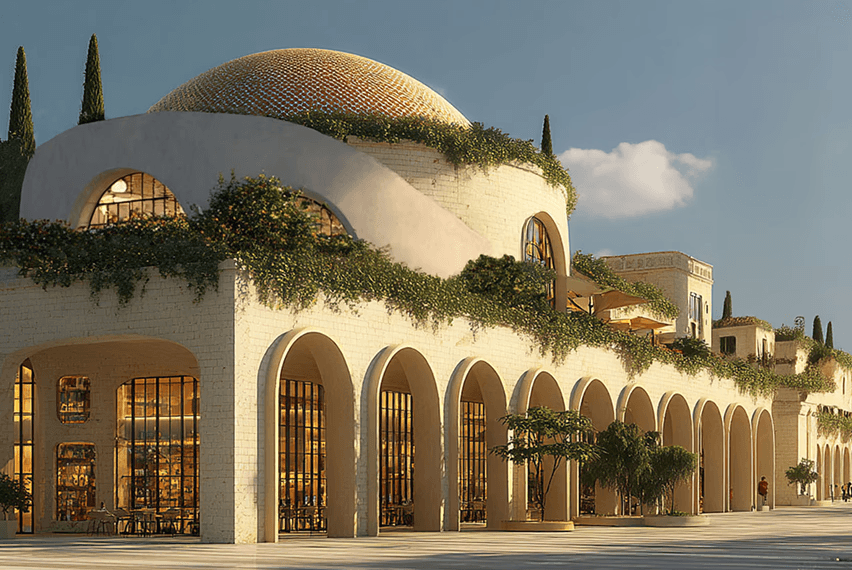
Exterior view of the Heart of Westwood
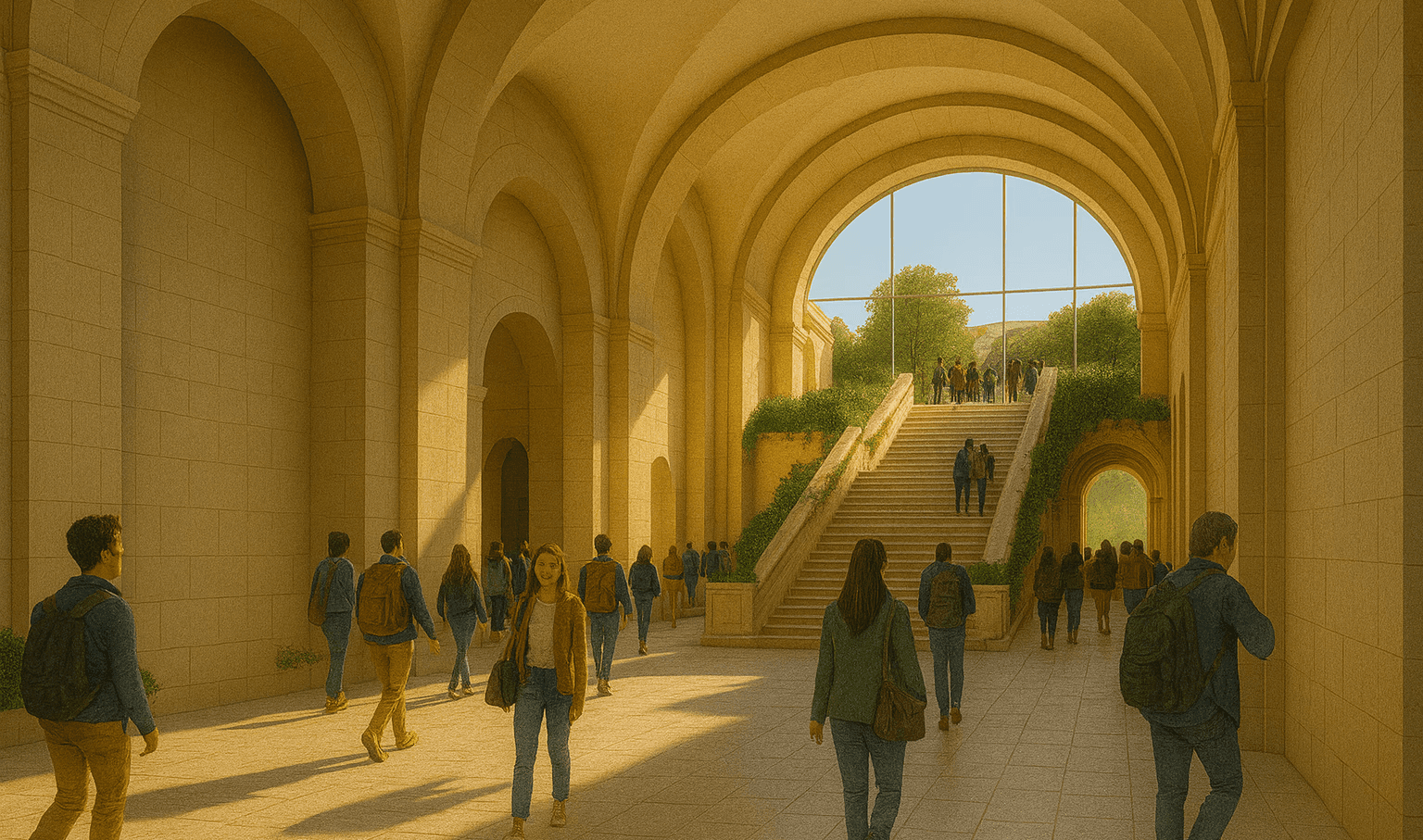
The indoor plaza, designed as a bright circulation space that connects people moving through the hub to different areas.
Impact
Heart of Westwood showed how a new metro line can become more impactful when paired with strong adjacent mobility infrastructure, rider amenities, and intelligent support services.
The concept reframed the site next to the D-Line as more than a parking structure. It became a strategic piece of public facing mobility infrastructure with the potential to improve transfers, reduce friction, support international visitors, and create more value for Westwood as a neighborhood.
The work was significant enough to be presented to BMW Designworks global leadership and guests from Los Angeles city government, which elevated it beyond a standard internship deliverable. It became part of a larger conversation around the future of urban transit, land use, rider support, and mobility design in Los Angeles.
For me personally, the project marked an important step in my growth as a designer. It showed that I can help lead complex work across research, systems thinking, service design, UX, visual execution, and stakeholder storytelling. It also helped me understand how product design skills can apply beyond screens, especially when digital tools are embedded inside a larger public environment.
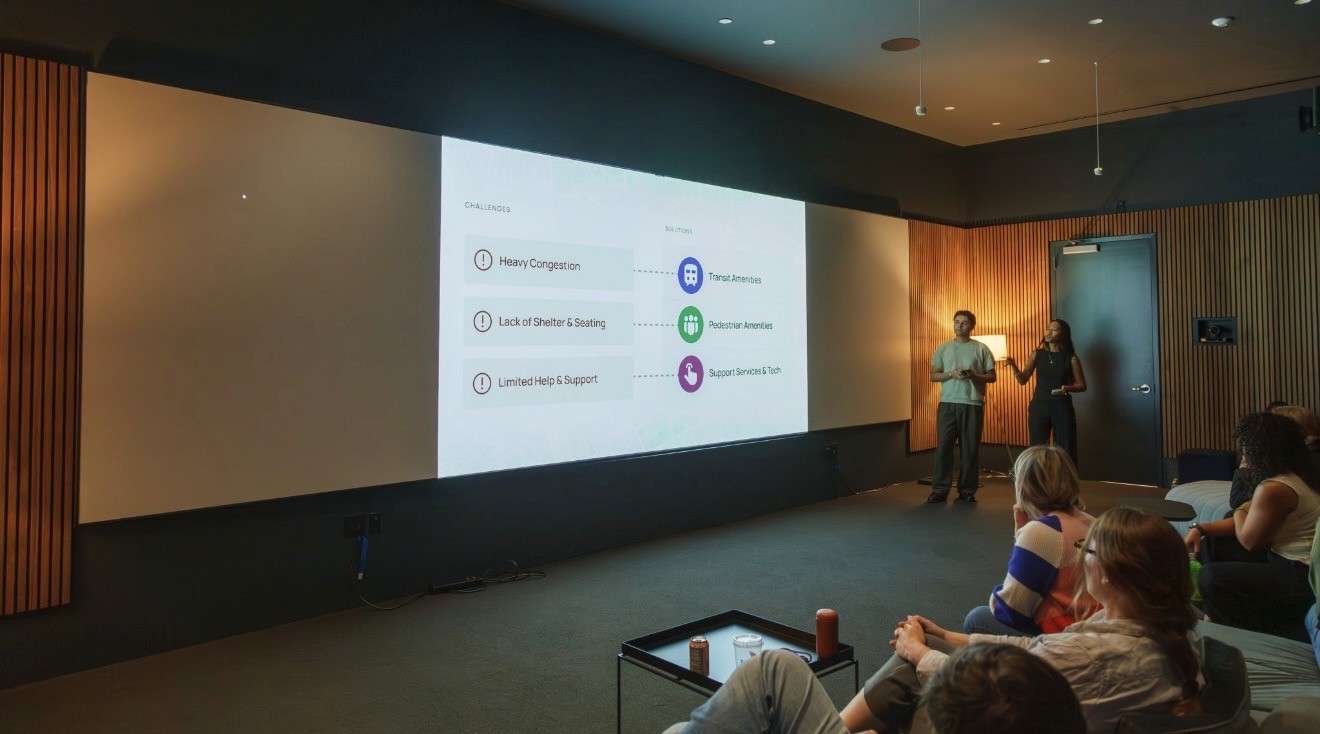
A moment from our final presentation, where we shared the mobility hub concept and key design decisions with BMW Designworks leadership and guests.
Me and my team, along with other BMW Designworks interns.
What I Learned
This project taught me how powerful it is to think about mobility as both a systems problem and a product experience problem.
Transportation design is not only about throughput, infrastructure, or moving people faster. It is also about reducing uncertainty, helping people make decisions, and designing moments of support into environments that can otherwise feel stressful or confusing.
I also learned how much value sits at the intersection of physical and digital design. The kiosk became strongest when it was treated as part of the architecture, circulation, and service logic of the hub. It was not just a screen placed inside a building. It was the user facing layer that helped people understand and use the larger system.
Another major lesson was the importance of strategic timing. A concept becomes more compelling when it is tied to a real inflection point. In this case, the D-Line made the project feel urgent, the 2028 Olympics added pressure, and Parking Structure 32 made the opportunity feel physically actionable.
I also learned that big concepts need clear evidence behind them. Ambitious ideas land better when people can see why they matter, why now is the right time, and what makes them plausible. For Heart of Westwood, that meant tying the proposal to a real site, real mobility pain points, real infrastructure investment, and a clear user facing service experience.
Reflection
Looking back, one of my strongest contributions was helping shape Heart of Westwood into a concept that felt both ambitious and grounded. I helped connect the site strategy to the rider experience, played a lead role in the kiosk UX, and contributed to the final storytelling that made the system understandable as a whole.
The most important thing we did well was avoid making the work feel like a generic future city proposal.
We tied the concept to specific conditions:
a real location
a real parking structure
a real Metro D-Line station under construction
a real land use opportunity
real commuter pain points
real support gaps for riders
a real need for better multilingual, route, and service assistance
I am especially proud of the kiosk work because it showed how AI could create practical value in public infrastructure. The kiosk was not about adding AI for the sake of it. It was about helping people complete real transit tasks: planning a route, understanding transfers, getting language support, using TAP services, discovering what is available in the hub, and leaving with directions on their phone.
If I were continuing the project, I would push deeper into operational detail and validation. I would want to prototype the kiosk assistant with real riders, test it across different user groups, and evaluate how it performs during peak commute and event scenarios. I would also want to explore the service model, maintenance model, staffing needs, safety considerations, and implementation pathway that could make the concept more viable.
Overall, this project reinforced the type of designer I want to be: someone who can lead from strategy, design across systems, and still shape the actual user experience with precision. Heart of Westwood helped me see mobility design as a space where physical infrastructure, digital tools, and human support can work together to make cities easier to move through.