GameStop Collectors Exchange
Overview
GameStop is a retail brand with an existing collectibles and trading card business, including sealed product, graded cards, and in store collector demand. But in that market, GameStop is still mostly positioned at the retail level, not as the central platform where ownership, trading, and market activity happen over time.
GCX, or GameStop Collectors Exchange, explores what that larger role could look like. I designed a fractional trading platform for high value graded trading cards, including Pokémon, sports cards, and Magic: The Gathering. The concept gives collectors access to grail tier assets that are normally too expensive to own outright, while making the experience feel structured, transparent, and credible enough to support real financial behavior.
Instead of treating cards as one time purchases, GCX reframes them as assets that can be discovered, evaluated, traded, and tracked. That required thinking beyond the interface. I needed to design an experience that accounted for collector behavior, trust concerns, market infrastructure, ownership structure, custody, insurance, and GameStop’s possible role as a platform in the category.
The goal was not just to make a polished trading card app. It was to build an end to end product concept that could feel believable in the real world.
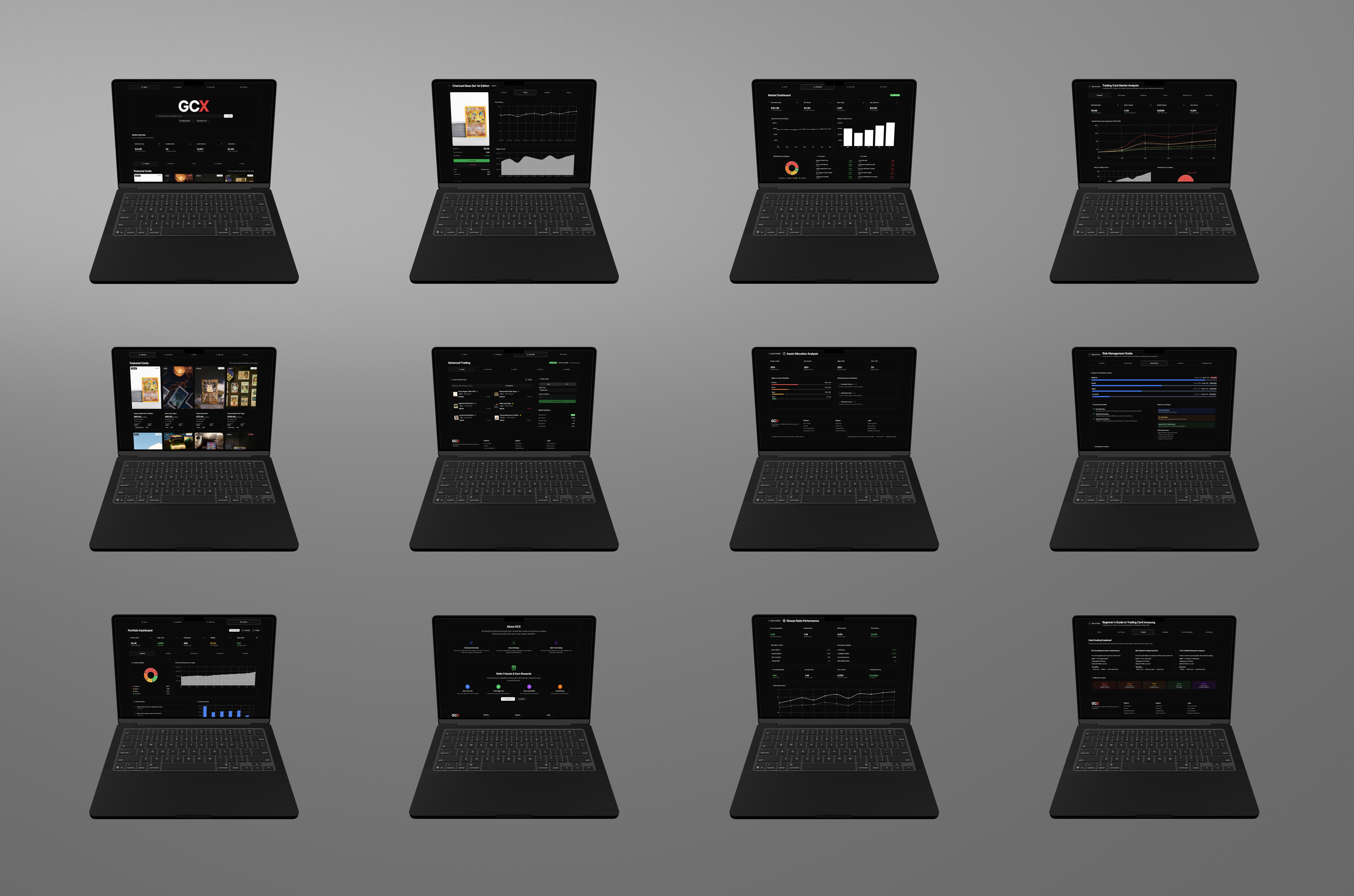
GCX prototype mockups showing major features and details.
Context
High end trading cards regularly sell for five or six figures, which puts full ownership out of reach for most collectors. At the same time, the market around those assets is difficult to navigate. Trust can be shaky because of counterfeits, disputed grading standards, and unclear provenance. Ownership introduces friction through storage, insurance, shipping, and theft risk. Selling is fragmented across eBay, card shows, Discord, auction houses, and private deals, often with inconsistent pricing, weak transparency, and slow payouts.
What made this project timely is that trading cards are no longer behaving like a niche hobby market. Market growth is strong, Pokémon and sports cards continue to drive outsized demand, and collector behavior increasingly resembles investing behavior. People track population reports, comps, charts, scarcity, and timing. They talk about cards in terms of upside, entry points, and long term value. Online, in store, and across adjacent markets, the category already shows the characteristics of an emerging asset class, but the infrastructure still feels informal and fragmented.
That gap created the core opportunity. Fractional ownership could give everyday collectors access to assets they could never buy outright, but only if the platform feels genuinely trustworthy. GameStop was uniquely interesting in that context because it already sits at the intersection of brand familiarity, collector culture, and retail distribution. The challenge was not just to make the product usable. It was to translate trust, proof, and operational credibility into a product experience strong enough to support a new ownership model.

A Pikachu Illustrator card sold for $5.3 million, illustrating the scale of the premium trading card market.

High value graded sports cards often sell for over $100,000, making them inaccessible to most collectors as full ownership purchases.
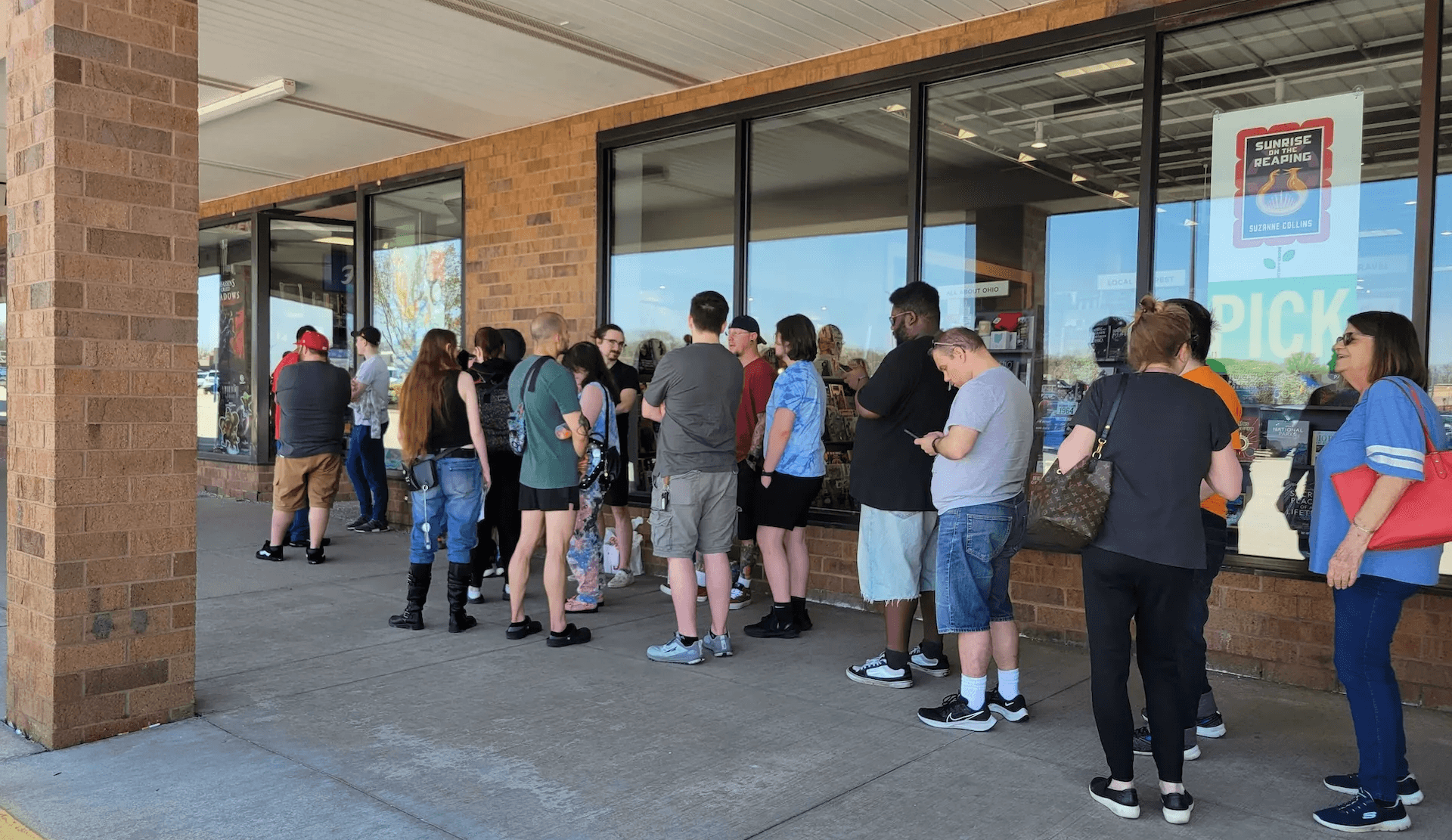
A line outside a GameStop store during a card drop, showing the strength of demand around trading card releases.
Research
I approached GCX as both a behavior problem and a trust problem. Before designing the interface, I needed to understand whether demand for a product like this was real, and what users would need to see before trusting it with their money.
My research combined secondary research, competitive analysis, community observation, and interviews. I studied the growth of trading cards and adjacent collectibles markets, then looked at platforms like Masterworks and Rally to understand how fractional ownership is explained and operationalized in other categories. I also analyzed collector and investor communities to see what people were actually discussing when evaluating cards.
That research quickly pushed me beyond normal marketplace design questions. If GCX was going to feel legitimate, I needed to understand the mechanics behind the experience: grading, vaulting, insurance, SPV-based ownership, primary offerings, secondary trading, custody, disclosures, and regulated partner infrastructure.
I also brought in direct category input. I interviewed Mitchell Walters, Head of GameStop Graded Card Operations, to better understand the card market, operational realities, and GameStop’s position in the category. I also conducted a field interview with a GameStop store manager to ground the concept in frontline customer behavior and in store demand.
A few patterns shaped the product direction. First, trading cards are already functioning like assets for many collectors. People care about price history, rarity, grade premiums, resale velocity, and perceived upside. That meant GCX needed to feel like a market, not just a resale marketplace.
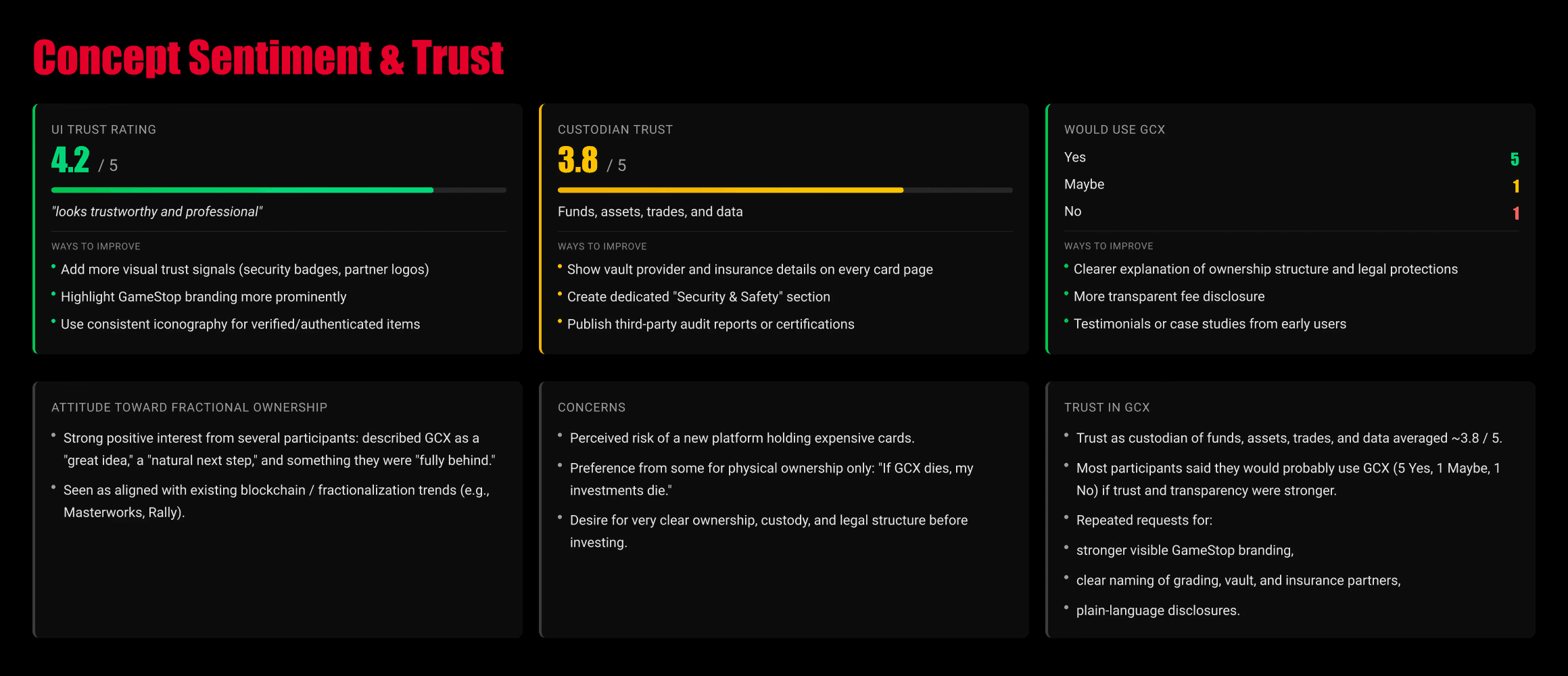
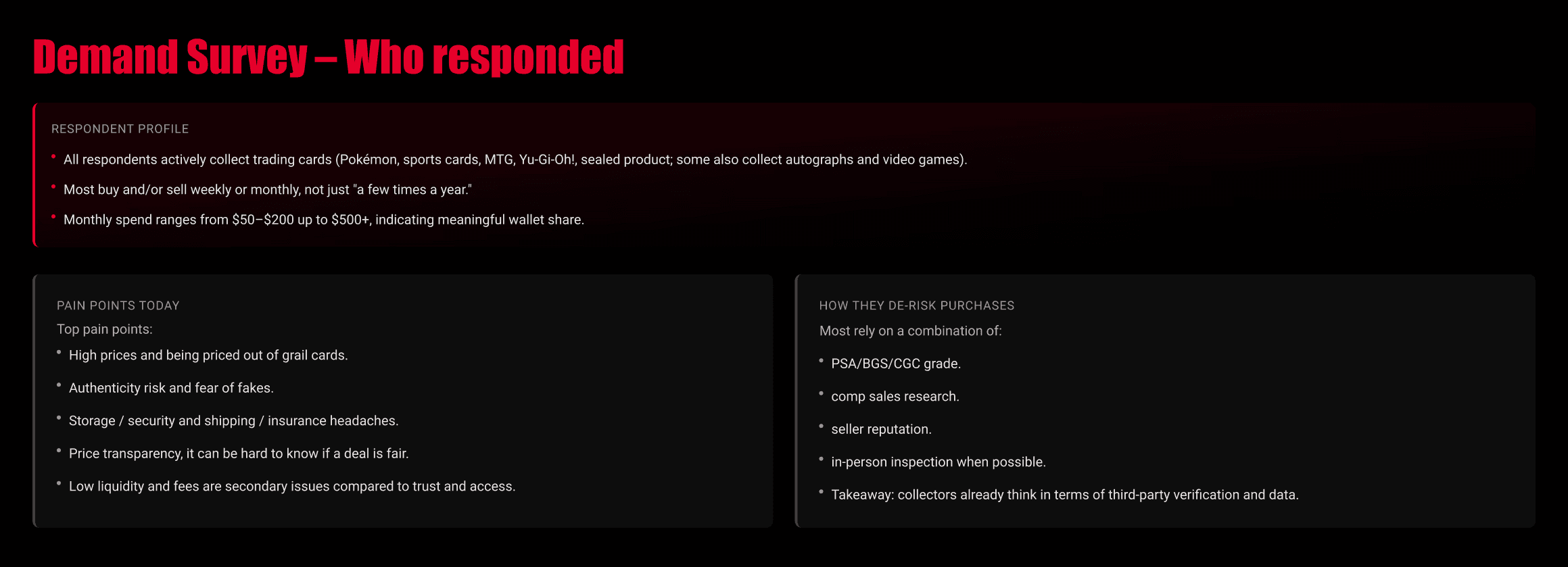
Second, trust depends on specifics. Users may be open to vaulting and fractional ownership, but only if the platform clearly explains who graded the card, who holds it, what insurance covers, what fees exist, what ownership means, and how cash out works.
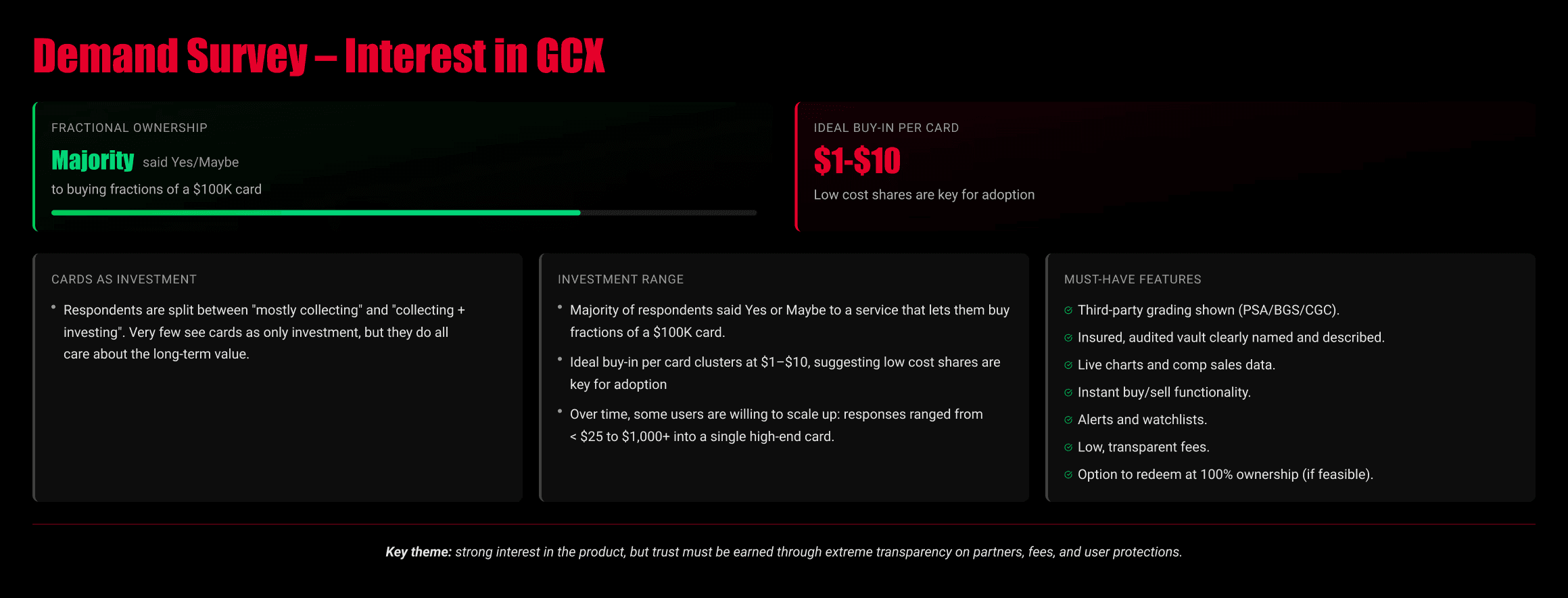
Third, low minimums could be a strong adoption wedge. Many users were interested, but they wanted the ability to test the system with a smaller amount of money first. That made first time participation its own design problem. The product had to reduce uncertainty before asking users to commit.
Together, these findings moved GCX away from a speculative collectibles app and toward a more structured exchange experience built around proof, clarity, and liquidity.

Images from my netnography, including collector and trading card communities.

Big collectors like Brady Hill see card collecting as a primary investment.

The GameStop location where I conducted field research to better understand customer behavior around trading cards.

Inside the GameStop store where I spoke with staff about card demand, customer interest, and in-store behavior.
Process
Once the research direction was clear, I translated the findings into a product structure. The most important shift was realizing GCX should not feel like a typical collectibles marketplace. It needed to feel closer to a brokerage product, because that was how many collectors were already thinking about high value cards.
That decision shaped the whole experience. I mapped the core product loop around discovery, asset evaluation, trade execution, portfolio tracking, and education. Each of those moments had to support both usability and trust. Users needed to understand what the asset was, why it had value, what they were buying, and what system sat behind the transaction.
I built the information architecture around the details that mattered most: card grade, price history, share price, market activity, ownership logic, custody, insurance, fees, and risk. These details could not be hidden in support pages because they were central to the decision making process.
As I moved into interface design, I focused on making the product feel active, structured, and financially legible without overwhelming users. The visual system emphasized market data, grade context, trading behavior, and portfolio visibility instead of leaning too heavily on collector themed styling. I wanted GCX to feel like a serious exchange, not a dressed up listing site.
The high fidelity prototype covered the full core experience: Home, Markets, Buy & Sell, Portfolio, Account, and Education. At that stage, the goal was not just visual polish. It was making the concept coherent enough that users and stakeholders could understand how GCX worked, why it mattered, and where trust needed to show up.

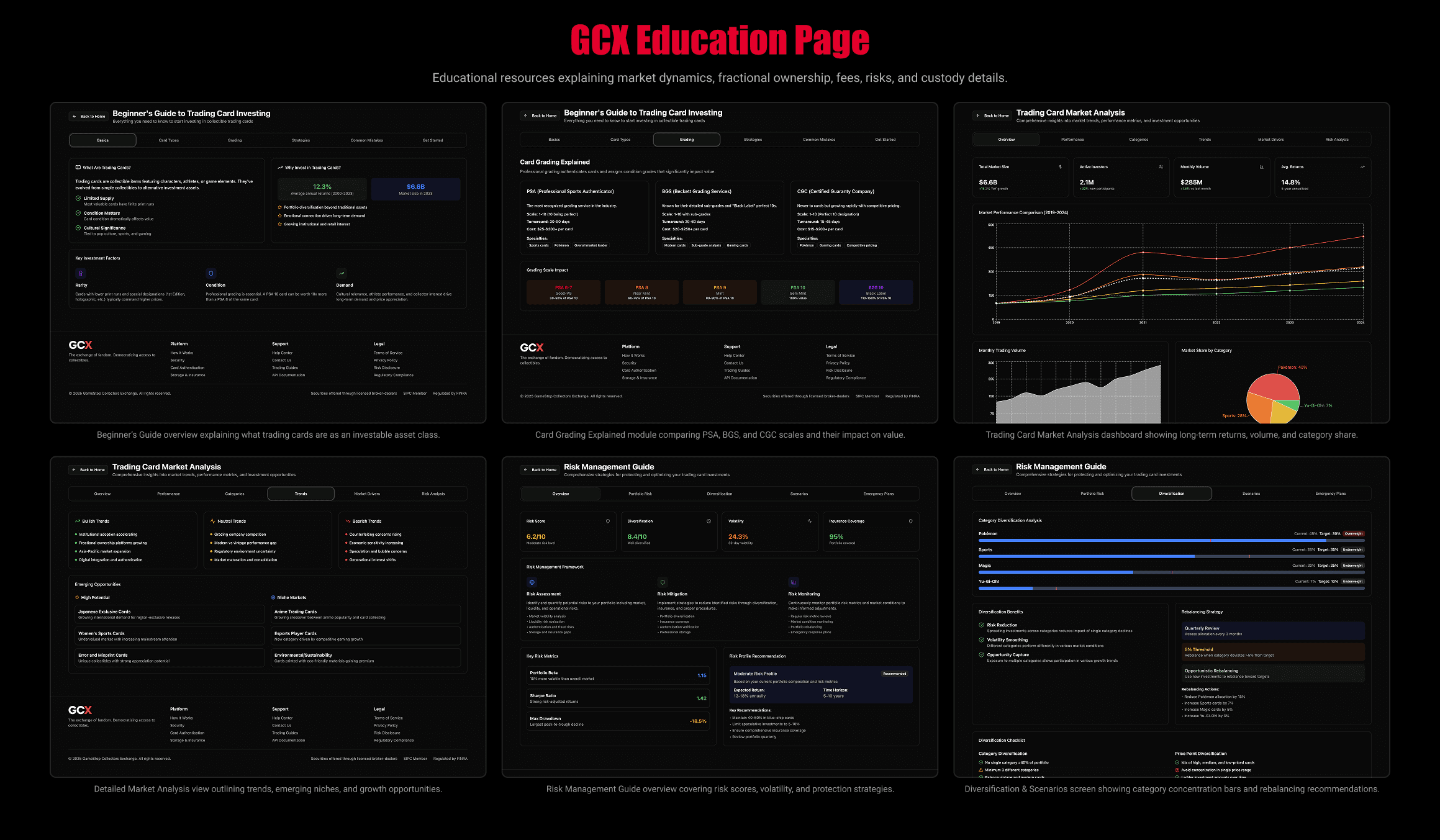
GCX prototype section showing trading card market analysis.
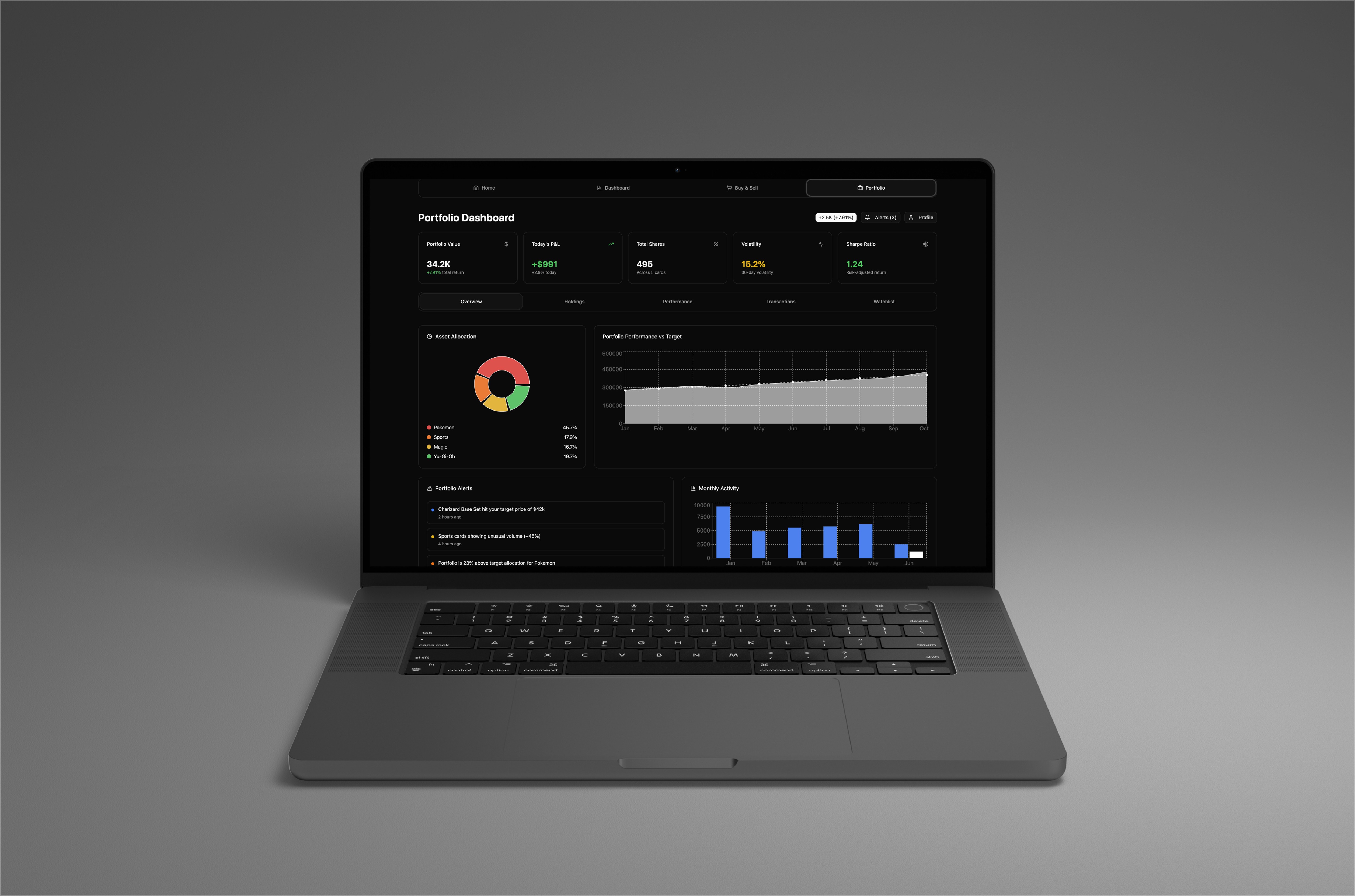
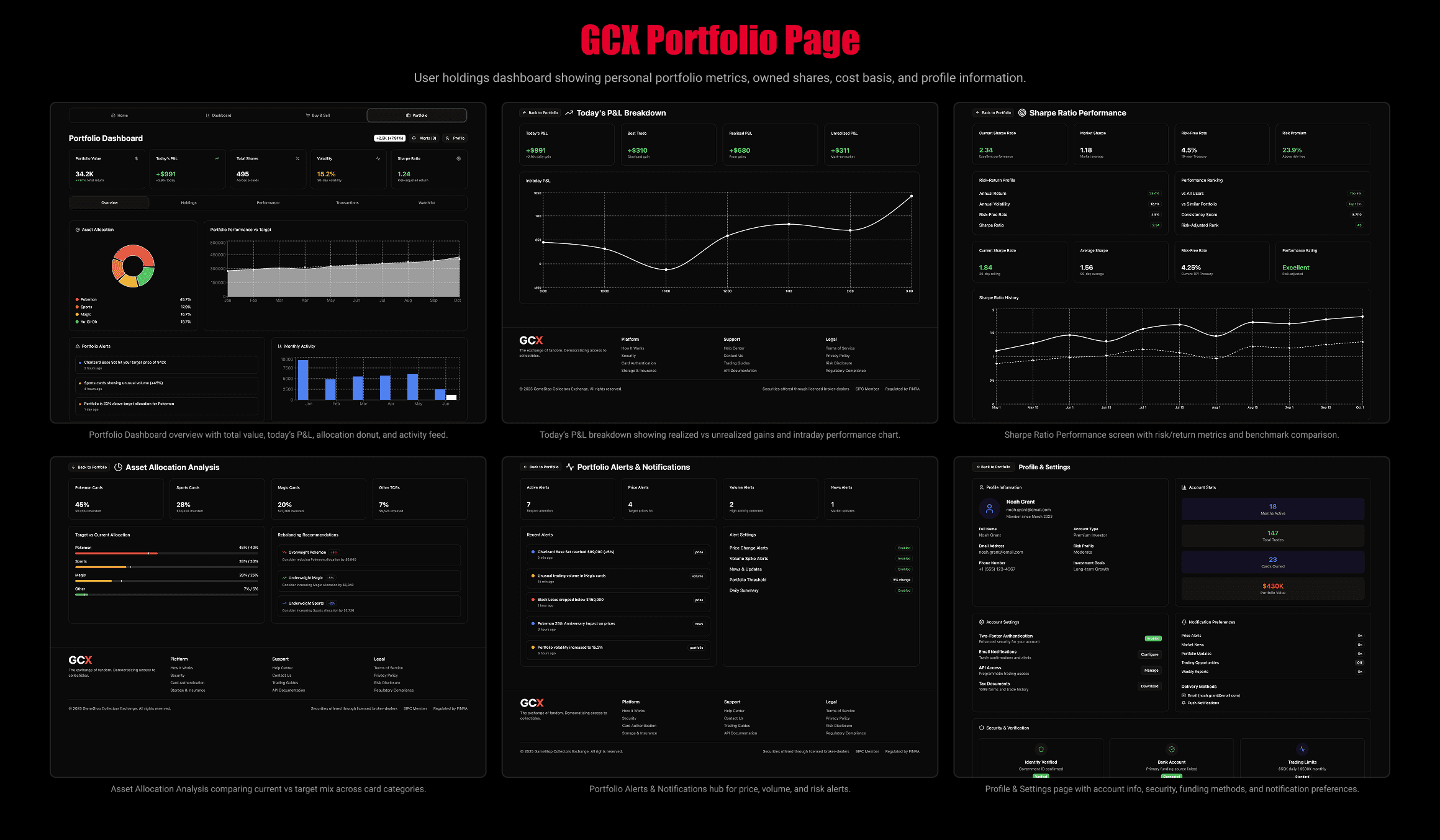
GCX prototype portfolio page.
Strategy
GCX needed a believable operating model behind the interface. A fractional trading platform cannot rely on visual design alone, especially when users are being asked to put money into an asset they do not physically hold.
I framed GCX as a platform business where GameStop owns the customer experience, sourcing layer, collector relationship, and brand trust, while specialized partners handle the regulated and operational parts of the system.
In this model, GameStop acquires or consigns a high value card. A trusted grader such as PSA authenticates it. A qualified custodian vaults and insures it. Each card is placed into its own SPV and divided into fixed shares. Those shares are first offered through a primary sale, then made available for secondary trading.
The product experience would surface the parts users need to understand: price history, share price, trading activity, ownership tracking, fees, custody details, insurance, disclosures, and cash out mechanics. Broker dealer, ATS, KYC, payments, and compliance infrastructure would be handled through third party rails instead of assumed to be built from scratch by GameStop.
This structure made the concept more believable. GCX stopped being only a front end idea and became a product direction that could sit within real operational and regulatory constraints. It also made the opportunity more strategic for GameStop. Instead of only selling cards once, GameStop could potentially participate in offerings, trading activity, portfolio engagement, and ongoing collector relationships.
The product principles became clear:
Users need enough market context to make informed decisions.
Trust details need to appear when users are deciding whether to commit money.
First time participation needs to feel safe enough that users are willing to try.
Those principles guided both the UX and the business architecture behind the concept.
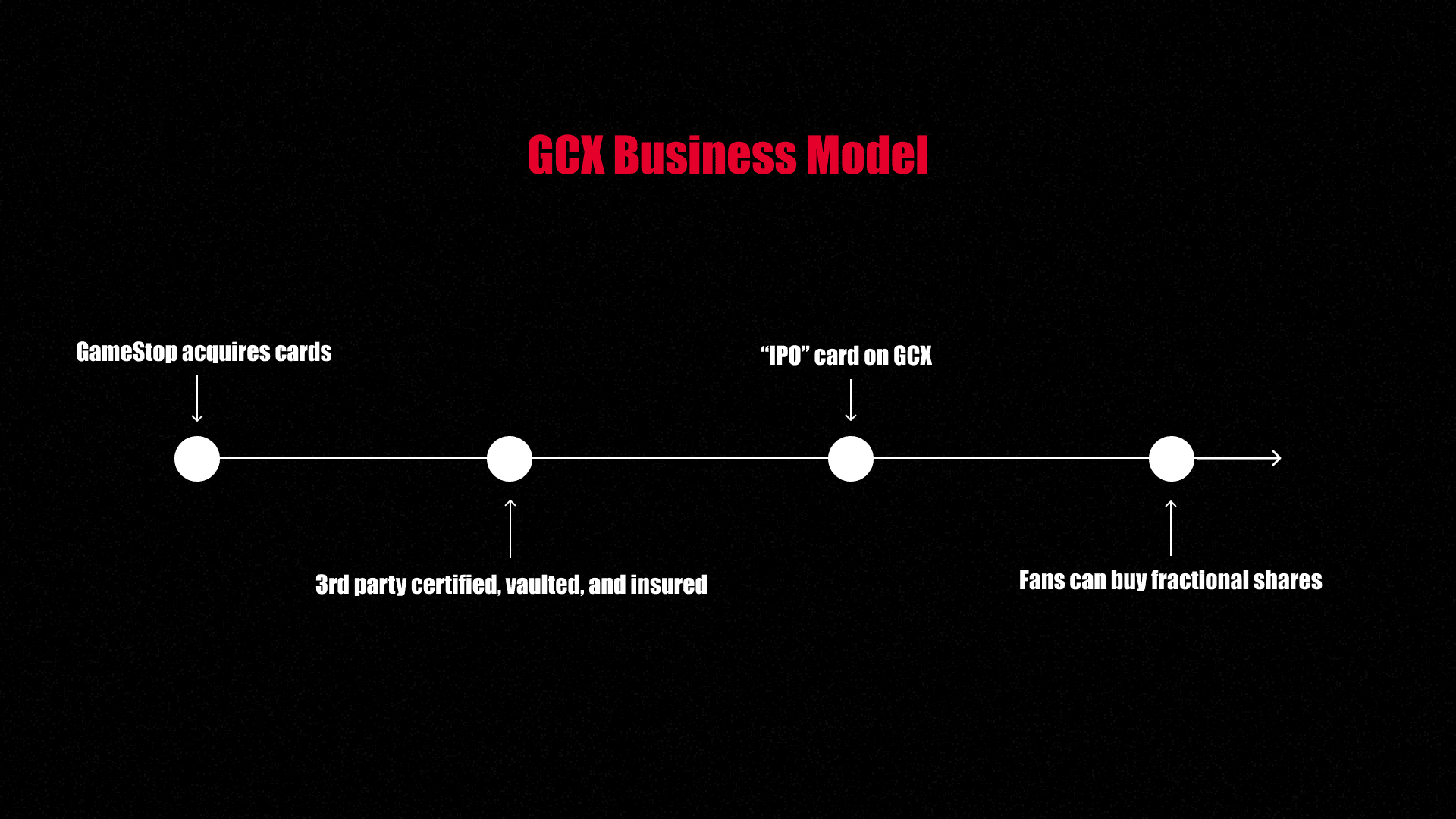
High level GCX business model. From GameStop acquiring cards, to fans being able to purchase fractional shares of them.
Validation
To validate GCX, I ran an unmoderated usability test with seven participants and paired it with a smaller demand and attitudes survey. I wanted to understand whether the concept was understandable, whether the product felt trustworthy, and whether users could complete the core flow.
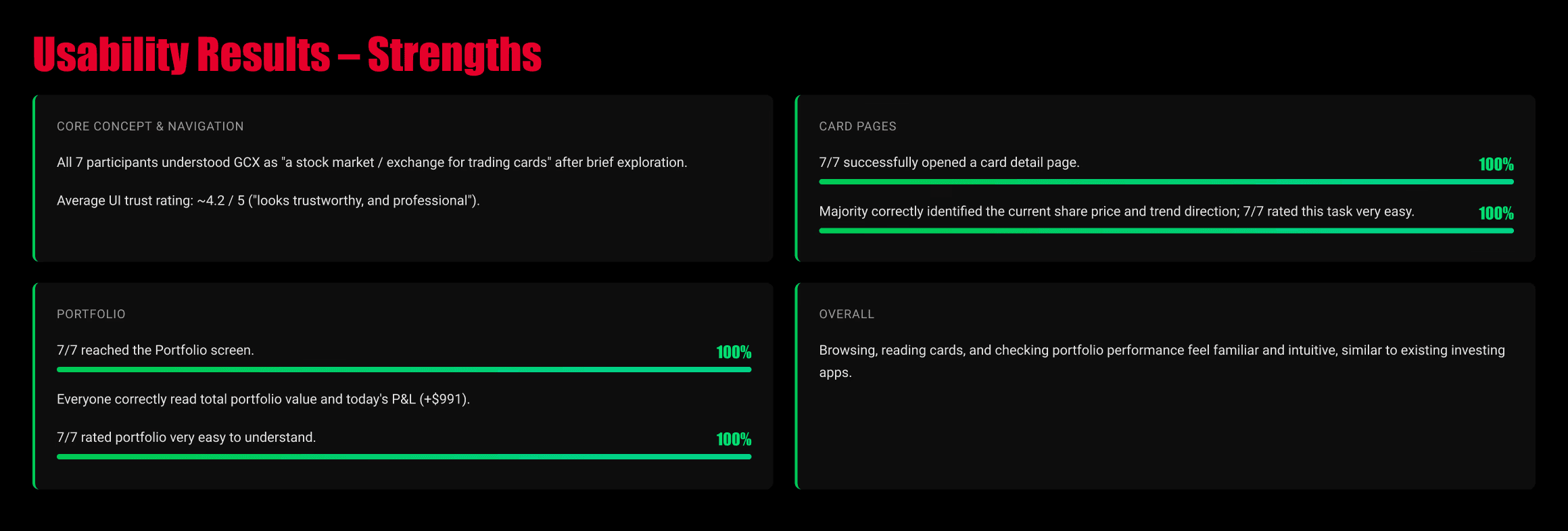
The strongest signal was concept clarity. Participants quickly understood GCX as a stock market style platform for trading fractional ownership in high value cards. That mattered because this is not a familiar product category for most people. If the interface could not explain the product clearly, the concept would fall apart.
The prototype also performed well in core navigation and portfolio comprehension. All participants successfully opened a card detail page, reached the portfolio area, and correctly interpreted total value and daily performance. The browse to asset to portfolio loop felt intuitive, especially for users familiar with investing products.
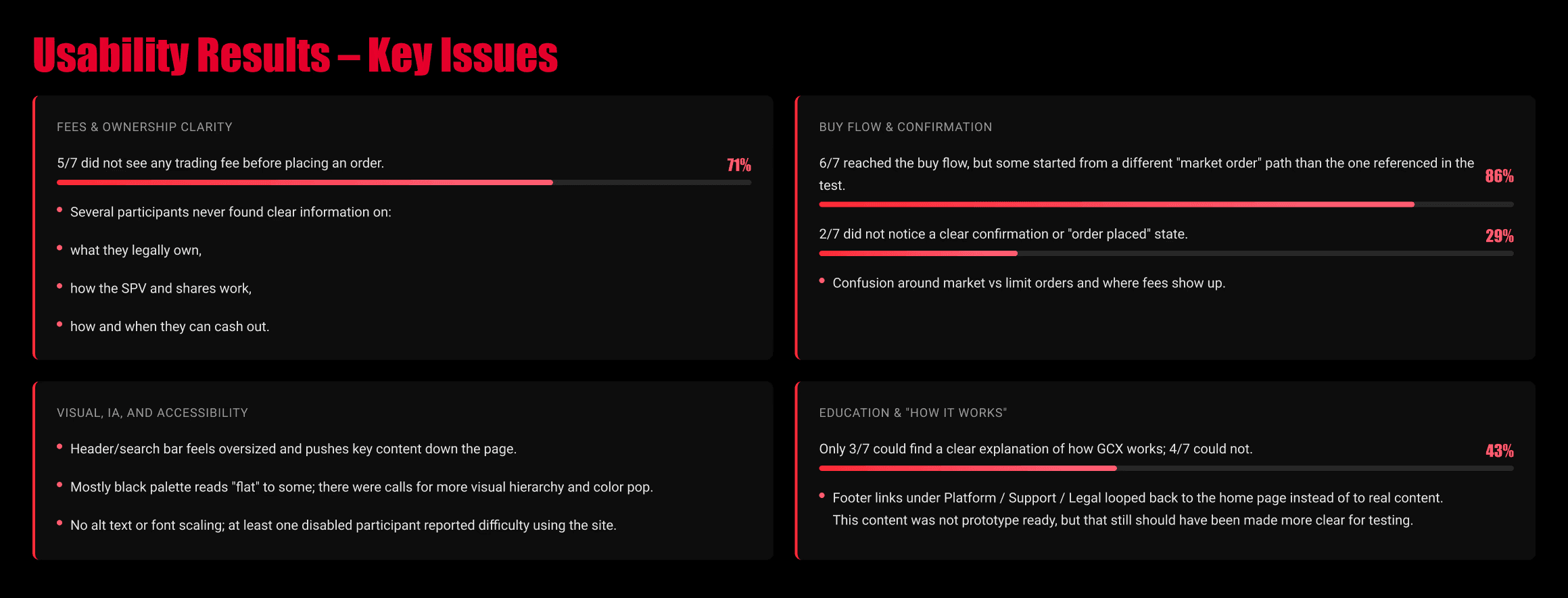
The biggest issues appeared around trust visibility and transaction clarity. Educational content was too hidden. Many participants did not notice fees before placing an order. Some were unclear on the difference between market and limit orders. The order confirmation also needed to feel more serious and more explicit.
Those issues were useful because they reinforced the central lesson from research: trust cannot sit in the background. It has to appear exactly where money moves. The next iteration needed to make education more visible, make fees unavoidable in the trade flow, clarify ownership and cash out logic, strengthen confirmation states, and improve visual hierarchy and accessibility.

User test participant Alex exploring the GCX prototype.
Solution
The final GCX concept is a fractional trading platform for authenticated, vaulted, and insured trading cards. Instead of requiring users to buy an entire high value card, GCX lets them buy and sell shares of specific assets through a market style interface designed around transparency, confidence, and ongoing engagement.
The product solves two problems at once. For collectors, it lowers the barrier to entry for a part of the card market that usually feels inaccessible and operationally intimidating. For GameStop, it creates a path toward a more scalable platform business built around marketplace activity instead of one time retail transactions.
The long term vision is larger than trading cards alone. GCX could become an exchange layer for collectibles, starting with graded cards and expanding into adjacent categories where authentication, custody, and liquidity are the main blockers.
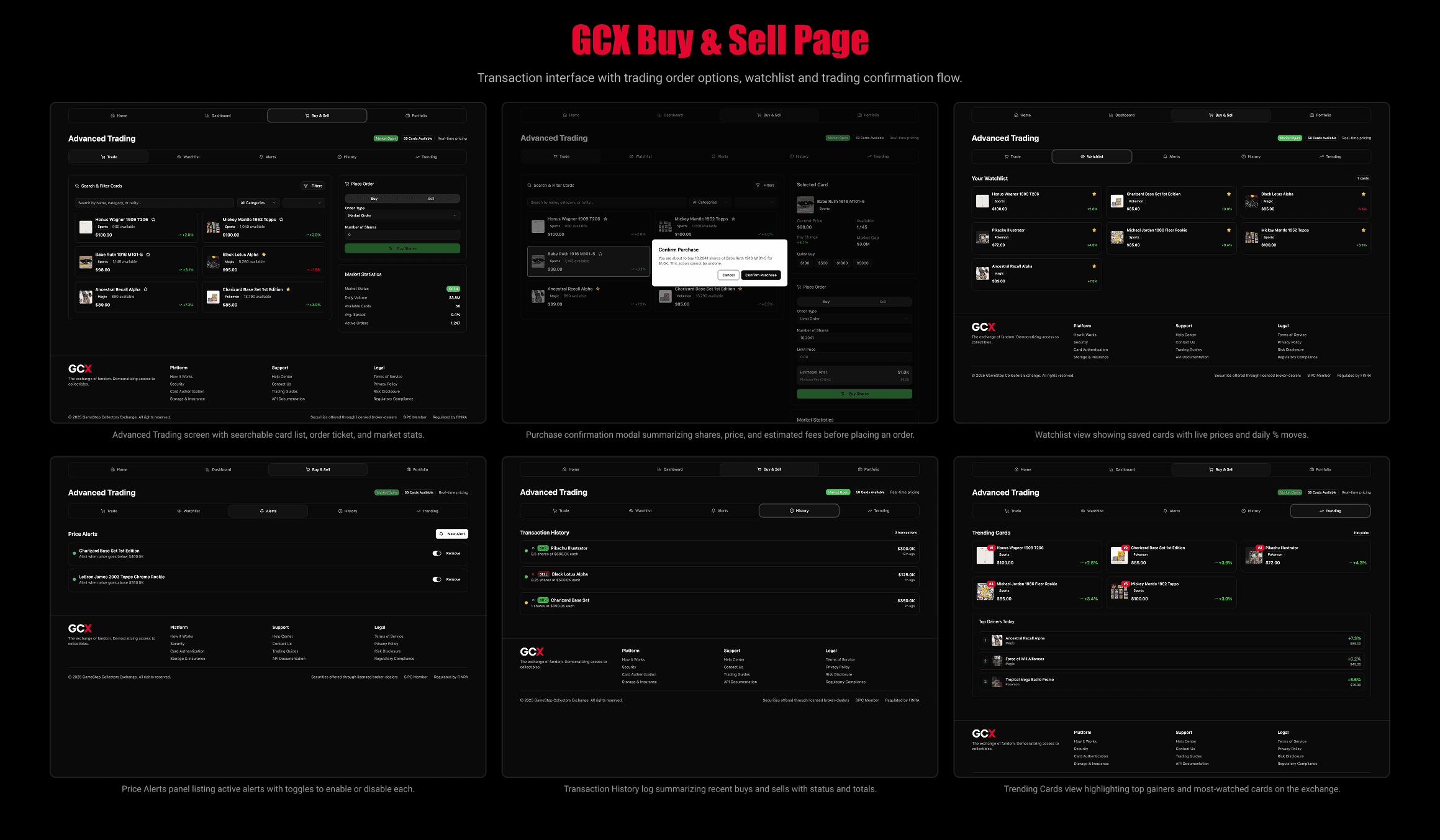
I designed a fully clickable desktop prototype covering the end to end experience. Users could explore the market, evaluate individual cards, place trades, monitor a portfolio, manage account information, and reference education explaining how fractional ownership works. The prototype was built to simulate a complex financial ownership product, not just a concept landing page, which made it more useful for testing and stakeholder communication.

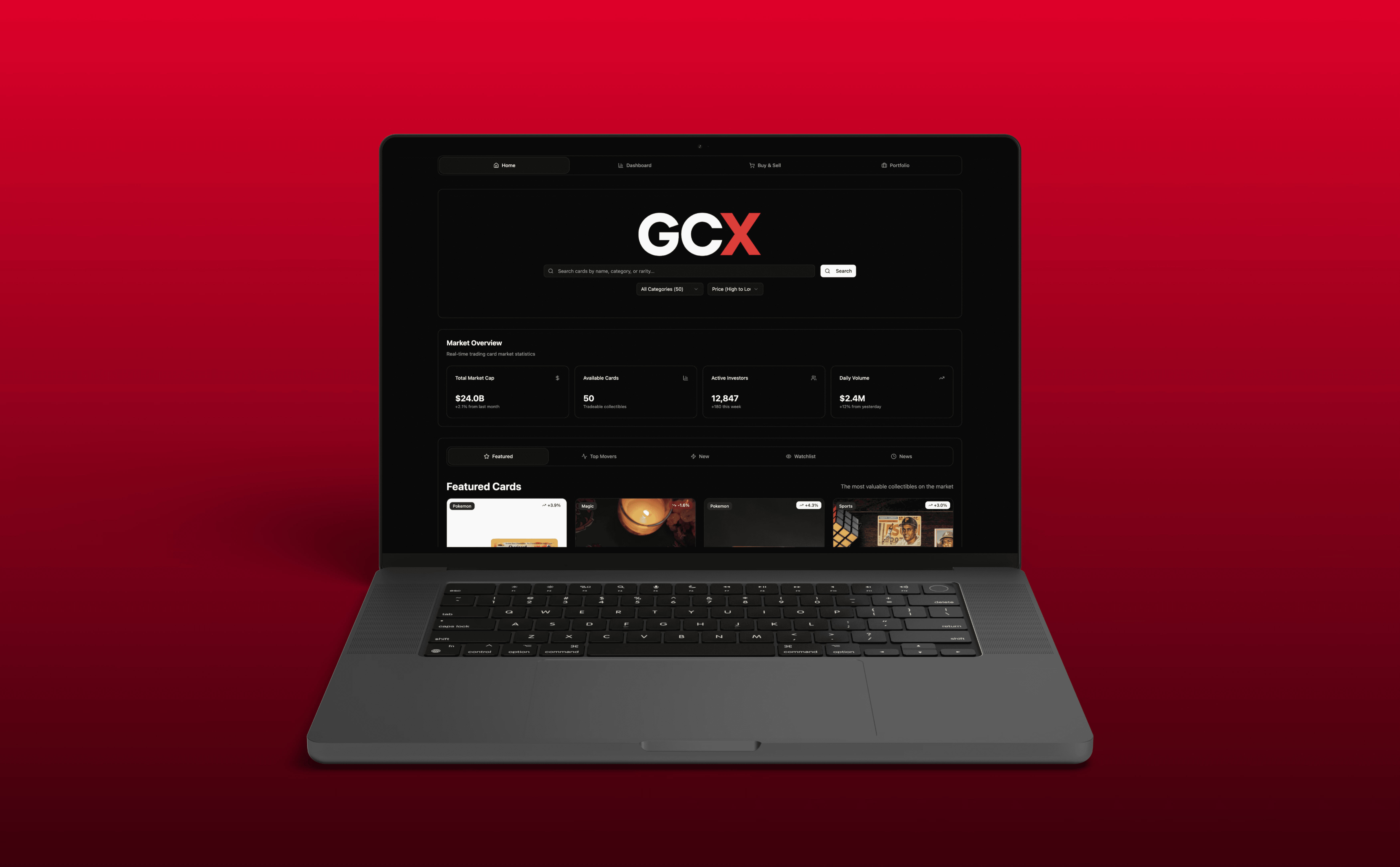
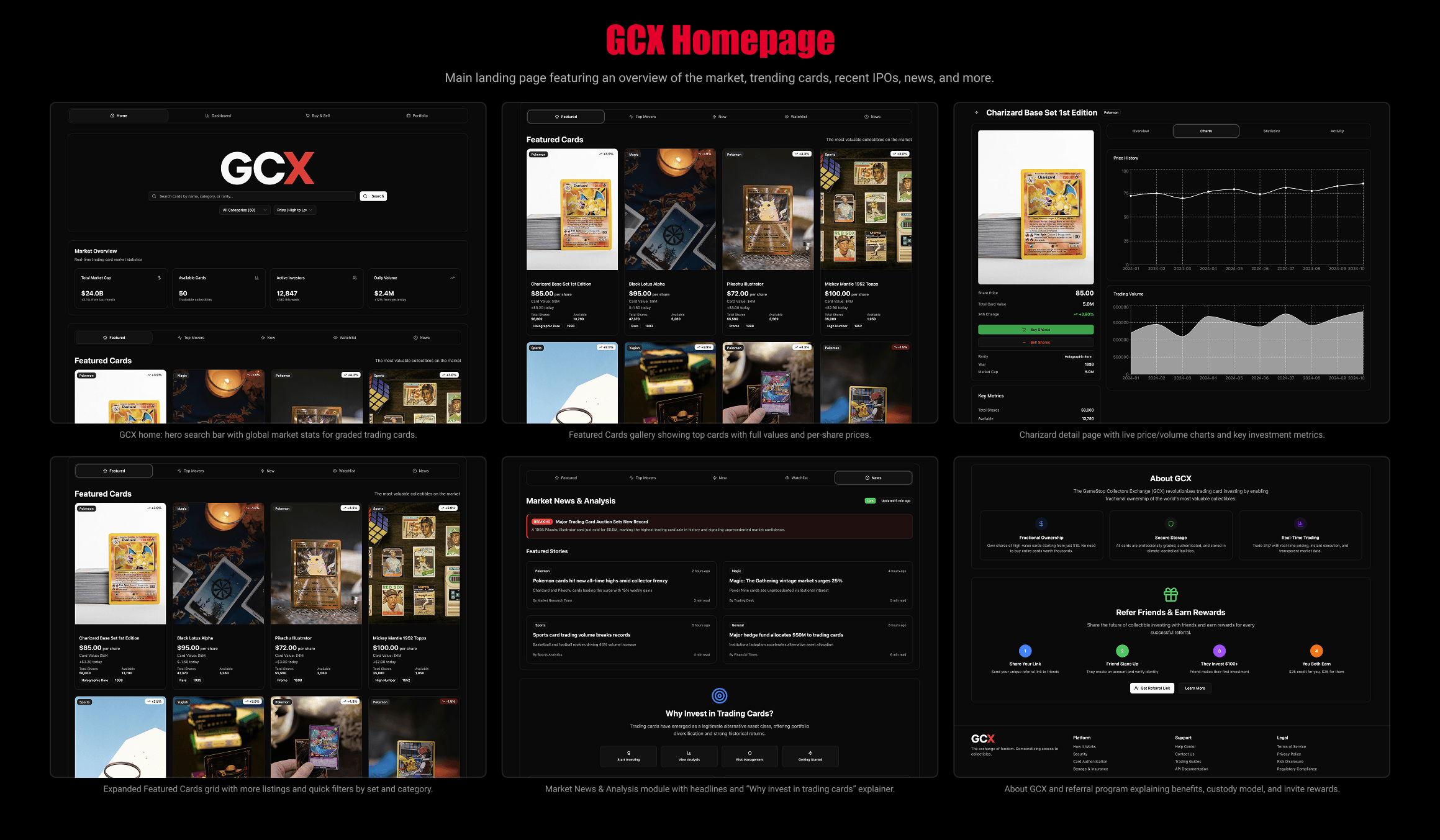
GCX prototype homepage
Key Features
Homepage
The homepage acts as both an entry point and a confidence builder. It combines search, featured assets, market snapshots, recent offerings, and lightweight educational content so users can start exploring without feeling lost. The goal was to quickly communicate that GCX is an active platform, not a static card catalog.
Market Dashboard
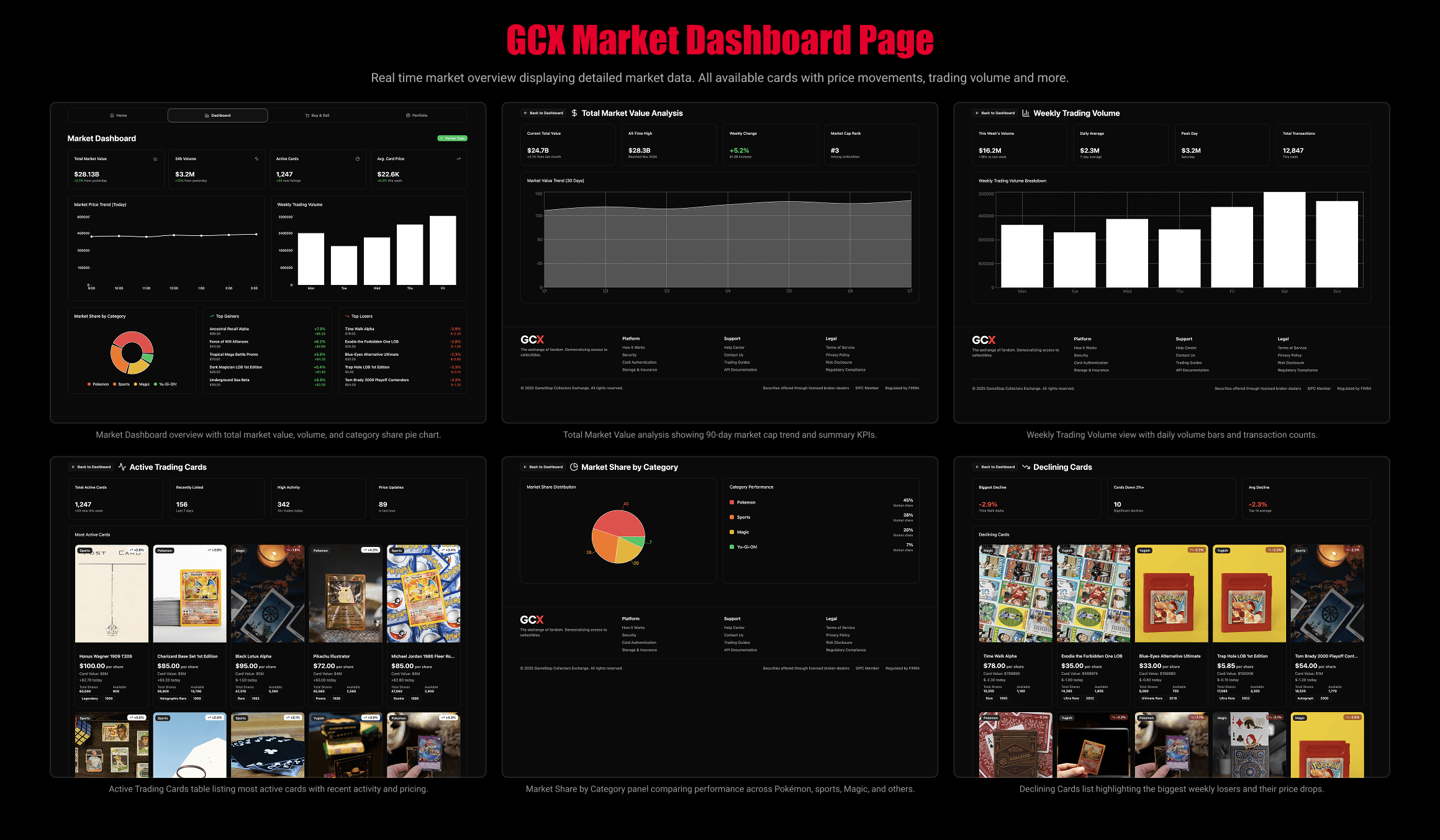
The market dashboard gives users a broader view of activity across the platform. It includes total market value, trading volume, category breakdowns, active assets, and movers. This helps position GCX as an exchange with real market behavior rather than a simple marketplace.
Asset Detail Page
The asset detail page is the main decision center. It brings together price history, card imagery, grade context, volume, share price, and trade actions. This is where valuation and trust meet, so the layout needed to support confident decision making instead of passive browsing.
Buy and Sell Flow
The buy and sell flow uses a structured order ticket inspired by brokerage products. Users can review the asset, choose an order type, see fees, confirm the trade, and track activity. The goal was to make trading feel familiar to experienced users while still understandable for newcomers.
Portfolio
The portfolio area makes ownership visible over time. Users can monitor total value, daily performance, asset allocation, and individual holdings. This was important because GCX is not just about buying into one card. It is about creating an ongoing relationship with a collectible asset market.
Education
The education layer acts as a trust mechanism. It explains grading, vaulting, insurance, ownership structure, risk, and how trading works. For a product like GCX, education is not extra content. It is part of the core product experience because clarity directly affects adoption.
Results
The most important formal result was that users understood the concept quickly. Even with minimal onboarding, participants recognized GCX as a structured platform for buying and trading fractional ownership in high value cards. That showed the core story was coming through in the information architecture and interface.
Testing also made the weak points clear. Users wanted stronger trust proof, clearer fee disclosure, and more explicit confirmation during trading. “How it works,” ownership structure, and cash out logic were still too easy to miss.
That turned broad concerns about trust into concrete design requirements for the next iteration:
Make education more prominent.
Make fees unavoidable inside the order flow.
Explain ownership and cash out mechanics closer to the point of action.
Strengthen confirmation states.
Improve above the fold hierarchy and accessibility.
The result was a clearer understanding of what GCX needed to become. The concept was legible and desirable, but the trust layer needed to be brought further into the core flow.
The Leak
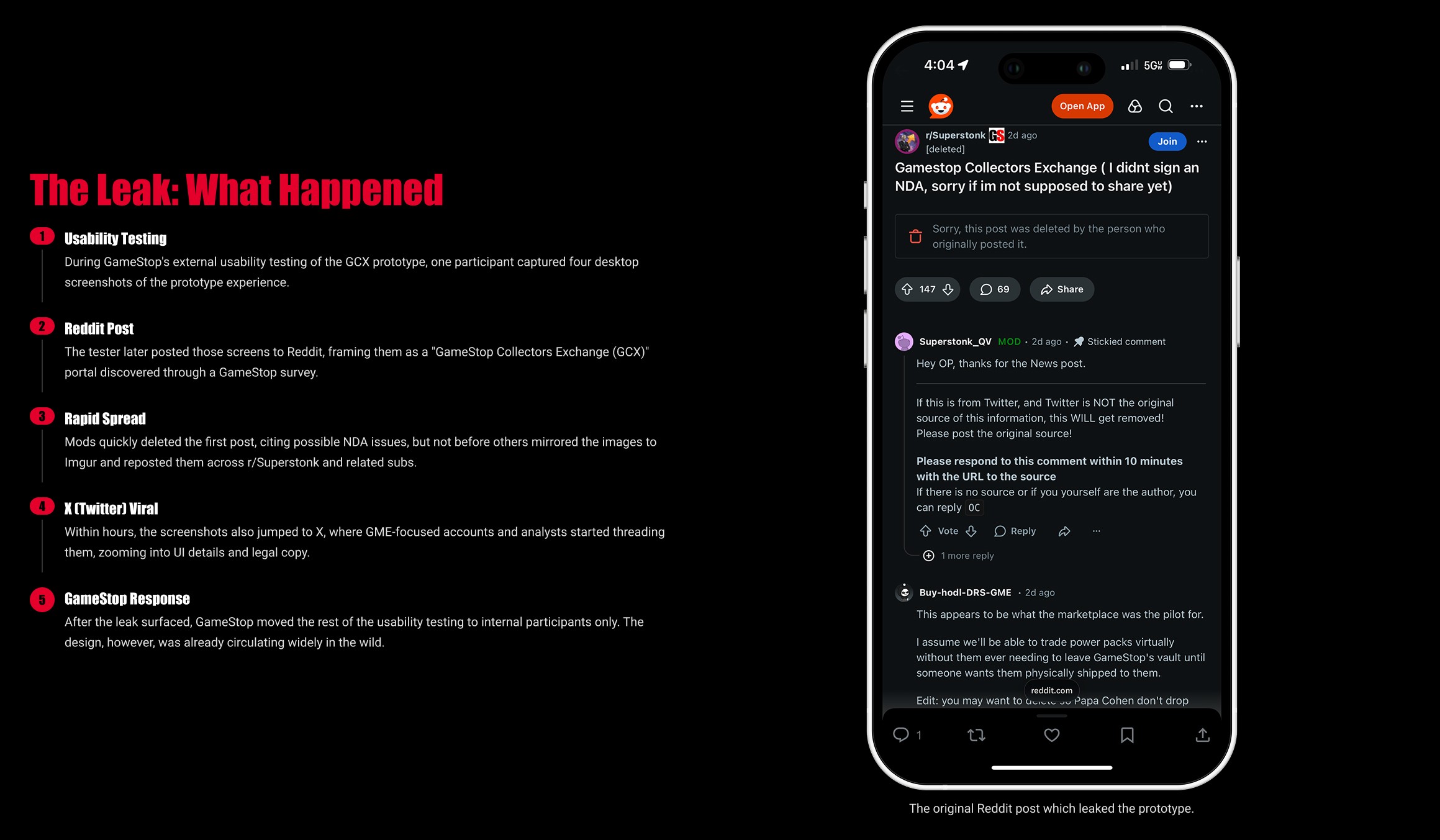
One of the most unusual forms of validation came from outside the formal study. During GameStop’s external usability testing, one participant captured four screenshots from the prototype and later posted them to Reddit as a “GameStop Collectors Exchange” portal discovered through a GameStop survey.
The original post was removed, but the images were mirrored to Imgur, reposted across r/Superstonk and related communities, and then picked up on X by GameStop focused accounts and analysts. After that, GameStop moved the rest of the testing internally, but the concept had already started circulating publicly.
What made the moment valuable was not just that it spread. It was how people interpreted it. Across Reddit, posts reached roughly 500 to 1.1k upvotes each, with many drawing 60 to 130 or more comments. People described the concept as a “Pokemon stock market,” “their own exchange but for collectors’ items,” and “a money printing machine.”
On X, commentators described it as a collectibles exchange with bank style custody. One analyst argued that the structure and legal language looked closer to a regulated broker dealer or ATS product than marketing art or an NFT concept.
The most useful signal was that people could reconstruct the product from the interface alone. Without an official explanation, they understood GCX as a dark themed trading portal for fractional ownership of high value graded cards. They picked up on the navigation, market metrics, per-share pricing model, custody language, and legal framing.
That mattered because the conversation quickly moved from “what is this?” to “how would this legally work?” People were not dismissing the idea as fantasy. They were evaluating it like a real financial product.
The leak also surfaced the exact reactions the project needed to understand. Some users immediately imagined fractional offerings for $20k to $100k cards or buying small positions in grail assets for around $20 a share. Others framed the concept as GameStop competing more directly with existing card marketplaces. At the same time, skepticism appeared in the right places: custody, broker dealer requirements, ATS compliance, ownership structure, and whether the platform could create enough liquidity.
That mix of excitement and serious scrutiny was a strong signal. It suggested the main barrier was not interest. The main barrier was trust, transparency, and proof.
In that sense, the leak became an unplanned large scale sentiment test. Four unannounced screenshots generated dozens of posts, thousands of upvotes, and hundreds of comments across collectors, speculators, and GameStop aligned retail investors. More importantly, the same themes from research and usability testing appeared again in public reaction: the concept was legible, demand was real, and trust would decide whether people adopted it.
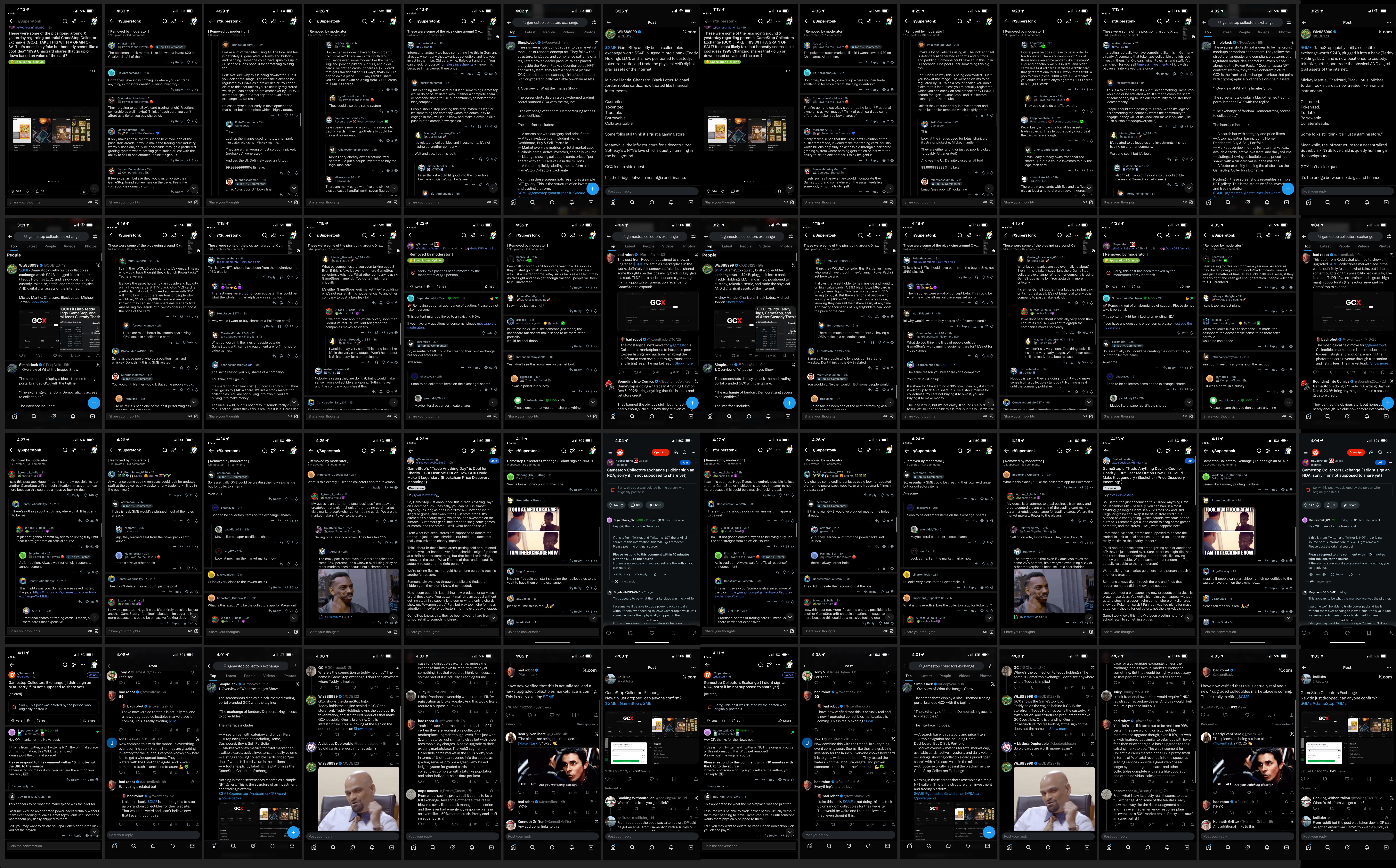
Screenshots of some of the posts and comments from the discussion around the leak.
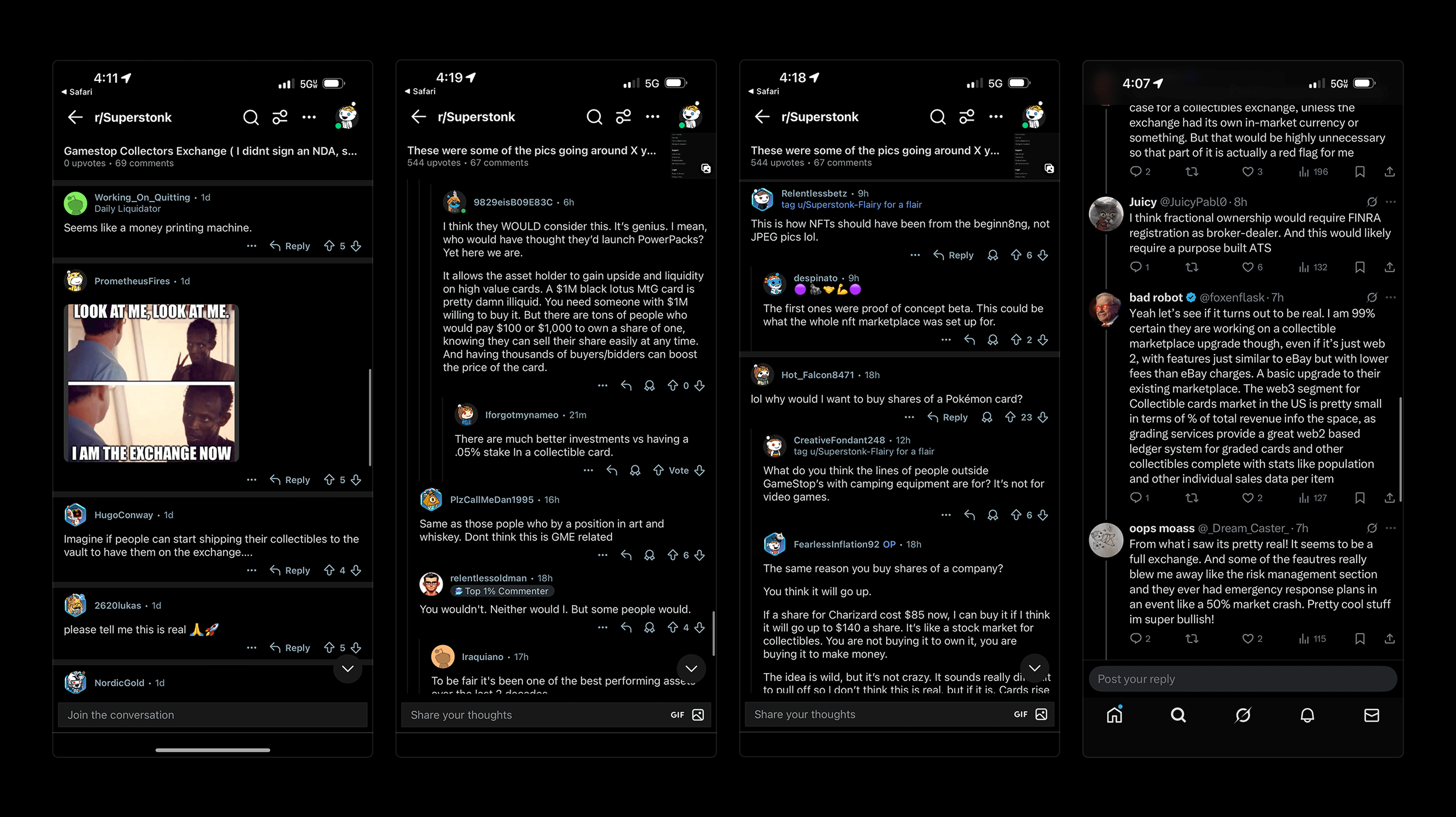
Reddit and X reactions showing enthusiasm for GCX and discussion of fractional ownership.
Impact
From a product perspective, GCX reframes GameStop’s role in the trading card category. Instead of participating only at the point of retail purchase, GameStop could build a longer term relationship with collectors through offerings, trading activity, portfolio engagement, and ownership services.
From a UX perspective, the project shows how design can reduce perceived risk in a category where trust determines adoption. The challenge was not just making the interface easy to use. It was making an unfamiliar ownership model feel understandable, legitimate, and actionable.
From a strategic perspective, GCX points to a larger platform opportunity. If the exchange model works for trading cards, the same framework could extend into other collectible categories where authentication, custody, and liquidity are the main barriers.
That makes GCX more than a one off concept. It suggests a possible path for GameStop to evolve from retail seller to exchange operator within collectibles.
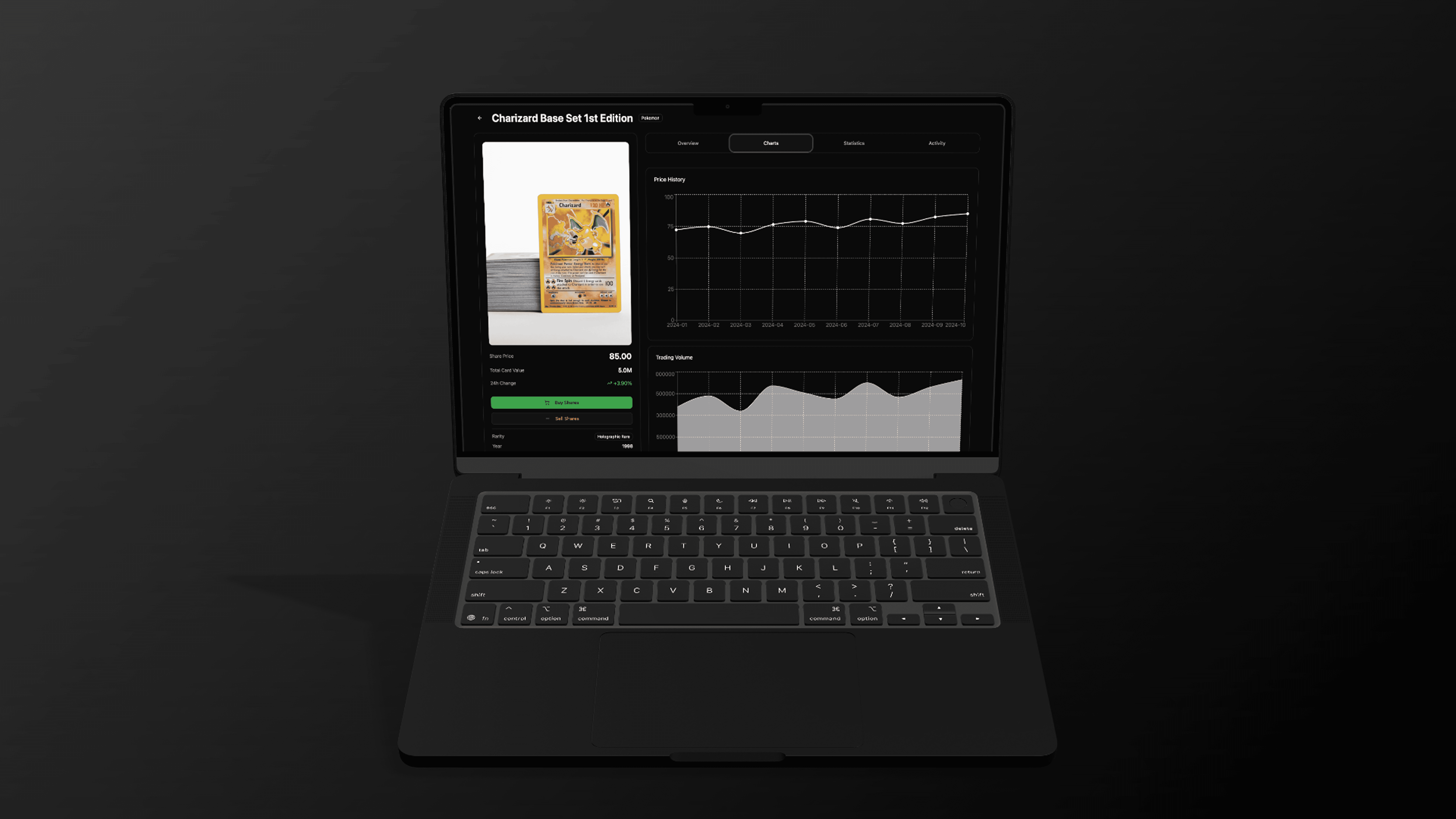
GCX prototype trading card detail page.
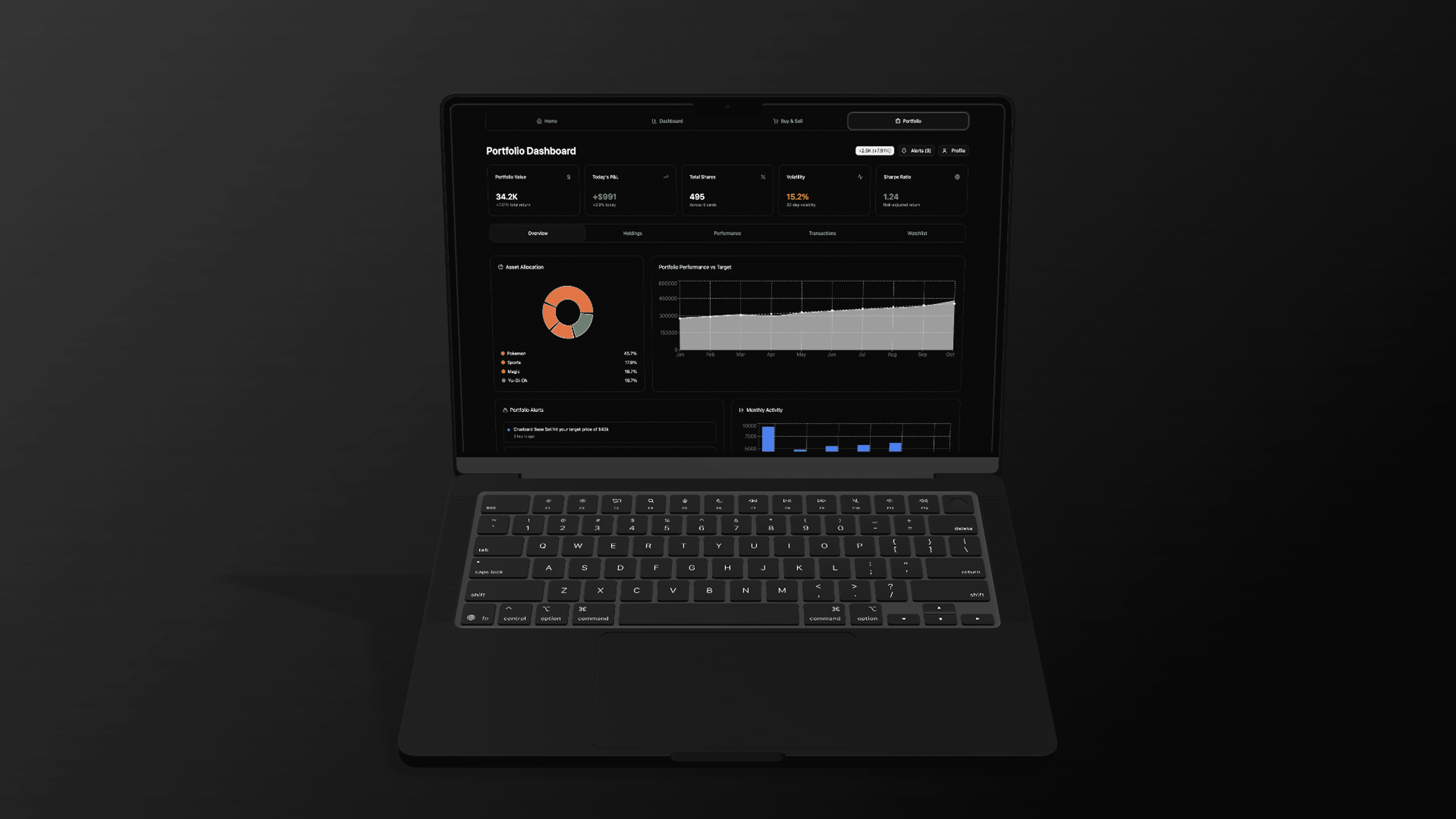
GCX prototype market dashboard page.
What I Learned
This project pushed me beyond interface design and forced me to think about product design more holistically. The biggest lesson was that trust is not something you add at the end. In a product like GCX, trust has to shape the structure of the entire experience.
It affects the information architecture, the language, the trading flow, the operating model, and the exact moments when users need proof before moving forward. A clean interface is not enough if users do not understand what they own, where the asset is held, what risk exists, and how they can exit.
I also learned how much stronger a concept becomes when it is grounded in operational reality. GCX became more believable once I designed around grading, custody, insurance, SPV ownership, partner infrastructure, and compliance constraints instead of treating those as background details.
The project also reinforced how important legibility is when designing something unfamiliar. If users cannot quickly understand what the product is, how it works, and why they should trust it, the rest of the experience does not matter.
GCX helped me see UX less as screen design and more as a way of making complex systems understandable enough for people to actually use.
Reflection
Building GCX end to end on my own was one of the most demanding projects I have worked on. It required me to move across research, synthesis, product strategy, systems thinking, interface design, prototyping, testing, and stakeholder storytelling while keeping the core idea coherent.
What I am most proud of is that the project did not stop at a surface level concept. It became a more complete product vision with a clear user value proposition, a believable operating structure, and meaningful validation around desirability, usability, and trust.
It also showed me that some of the most important design work happens before visual polish. The strongest parts of GCX came from framing the problem clearly, understanding the system behind the product, and turning a vague opportunity into something testable.
My biggest takeaway is that the demand side of this opportunity already exists. Collectibles are increasingly being treated like assets, and the real barrier is not interest. It is infrastructure, trust, and clarity. GCX was my attempt to design around that reality and show how a product could bridge the gap between collector enthusiasm and a more formal, accessible ownership model.